

Cut nails have been used in Sweden since the 19th century, and perhaps to some extent in the 18th century too. Many houses and farms, boats and furniture, boxes and more have been nailed with cut nails. In Sweden they were made at many ironworks, but most, if not all, have now closed. Our nails come from Tremont Nail Co in the USA, one of the last makers of cut nails. We have brought in most types and lengths from their range.
Brads (Tremont): this cut nail is used where you want minimum visibility. The idea is to drive the whole nail into the material so that nothing sticks out. Brads are used for interior joinery such as window and door architraves, skirting boards, cornices and more. Also a suitable nail for furniture.
Cut nails for furniture carcasses, panelling and the like (Tremont)
This cut nail suits places where you don't need to hide the head, i.e. where it doesn't matter if it shows. The nail is suitable for clinching (a method of "turning" the nail on the back like a staple, which makes a joint many times stronger). Suitable for walls, wide boards, doors, panelling and similar. Sometimes also called "klinkspikning" in Swedish. Whether the word is borrowed from the English "clinching" or the English borrowed it from the Nordic languages, perhaps someone else can tell us!
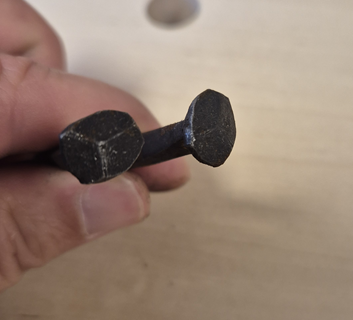
One variant has a head shaped like a wrought nail: very good-looking and much cheaper than a genuine wrought nail!
One thing to bear in mind is how you drive the nail into the wood. Because the nail has a rectangular, tapering profile, it should be placed so that it doesn't split the wood: drive it along the grain, not across it.

I visit the odd flea market in the summer, and sometimes I am lucky enough to find unused cut nails. I don't hesitate to buy a handful, as long as the price is right.
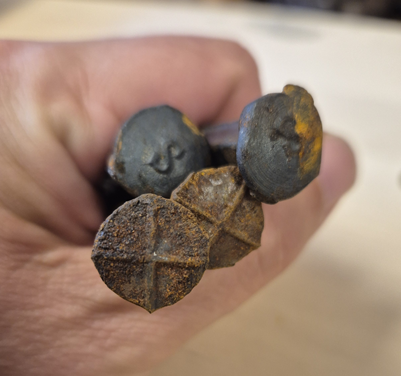
Cut nails from a flea market.
Share this content