Handplanes
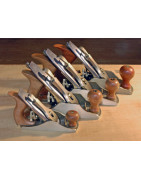
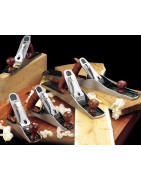
Planes, handplanes from wellknown makers.
Subcategories
-
Veritas Planes
Over the past half-century, plane makers have focused more on cutting production costs than on making planes work better. For our planes, we chose to focus on better adjustment and feed mechanisms, features to prevent blade vibration, and blades offering a choice of bevels and metallurgical properties to suit your preferences. We’ve also introduced customizable planes.
Materials, Manufacturing and Design
All Veritas plane bodies are fully stress-relieved ductile cast iron, which is dimensionally stable and takes hard knocks without cracking. To allow fast, accurate adjustment, parts are machined to exacting standards in our factory, ensuring a precise fit. Milled and surface ground to a high degree of finish, the soles are flat and square to the sides. Most of our bench planes have extra-large side wings for stable shooting, and a large hardwood front knob and rear tote that provide excellent control and comfort. Most also have a Norris-type combined feed and lateral adjustment mechanism for easy and accurate blade setting. On all bench planes, shoulder planes and block planes (except the apron plane), set screws in the sides prevent the blade from shifting when it hits a knot.
Choice of A2, O1 or PM-V11 Lapped Tool Steel Blades
Veritas bench, bevel-up and block planes (standard and low-angle) come with lapped blades made of O1, A2 or our PM-V11 tool steel. Choice of blade type depends on your preferences – how you like to work, how much planing you do and your sharpening methods.
Our O1 blades are oil-quenched and double-tempered to Rc58-60. While O1 sharpens more easily than A2 or PM-V11, it also dulls more readily. O1 blades are a good choice for rapid honing, but require it more frequently. Our A2 blades are air-quenched and double-tempered to Rc60-62. They hold an edge longer than O1 but require more effort to sharpen. A premium blade material, our PM-V11 tool steel (Rc61-63) has a fine, consistent grain structure that provides significantly greater resistance to damage from both impact and wear than O1 or A2, yet is as easy to sharpen as A2. PM-V11 has metallurgical properties particularly well suited for plane blades. It can take a keen edge and hold it at least twice as long in use as an A2 blade before needing sharpening; once dulled, the edge can be quickly restored using water stones or other common sharpening methods. Visit pm-v11.com for more information on the performance of these steels.We lap all of our blades* on the face to a flatness tolerance of 0.0005" or better over the working surface†, with an average roughness of 0.000005" or better. While the blade faces are smooth and true, the intersecting bevel should be honed before use.
* except Veritas scrub, scraping, router and flush plane blades, and all Veritas A2 toothed blades.
† On regular and bevel-up blades, the working surface extends from about 1/8" below the screw slot to the edge; on shoulder and bullnose plane blades, it is the widest section of the face from the shoulder to the edge.
-
Veritas Custom Bench...
Veritas Custom Bench Planes
A new concept in plane design, these are traditional bench planes that can be customized to fit the work you do and the way you do it. You choose the bed angle, blade material, even the size and style of the knob and tote allowing a level of personalization previously limited to handmade planes.
Each part of the plane is machined in our shop for accuracy and fit, ensuring that the plane functions as a unified whole no matter which parts you choose. -
Lie-Nielsen toolworks...
-
Clifton handplanes
Clifton handplanes
Clifton Bench planes are an accurate, smoothly functioning tool for the cabinet maker and discerning woodworker, whether amateur or professional.
-
Bench Planes
Smoothing planes that gives you a nice smooth surface No. 1 to the number 4 1/2. Each has its own charm, but personal preference plays a large part in choosing the right bench plane for a particular job.
-
Block Planes
End-grain moulding plane, the moulding plane is a plane with a flat sole and a small cutting angle for planing end-grain wood. One part has a steel end. The mouldboard has a cutting angle of about 21 degrees or less, the mouldboard is used for fitting end grain against rods in, for example, boat building and other fine carpentry, often used in conjunction with a butt box.
Butt planes are also popular for planing bamboo for making fly fishing rods, check out Edgeforum and ScandinavianSplit Cane Forum formore information and inspiration!
-
Fore Planes and Jack...
Fore Planes and Jack planes
The fore plane is a traditional English tool used to get rough boards fairly flat so that you can then make them really flat with a jointer plane and ready to finish with a smoothing plane, scrapers and (sometimes) sandpaper.
To quote an article from Lee Valley:
Armed with only three planes, you can convert a rough-as-a-cob board to something ready to finish. The techniques to do this are so well prescribed that they were written down in the first English-language woodworking book, Joseph Moxon's Mechanick Exercises.
The most notable thing about Moxon's book is that the tools and techniques are the same now as they were in 17th-century England. The only difference is that these techniques and skills were once common—now they are quite rare.
To convert rough stock into something suitable for furniture, you need three hand planes: a fore, a jointer and a smoother. The fore plane removes material quickly, the jointer plane makes the work flat and the smoothing plane prepares it for finish.
The fore plane is about 14" to 18" long (a jack plane will do) and has a cutting edge with a thumbnail shape. This shape allows it to remove lots of wood. The jointer plane is 22" or longer and has a cutter that is either straight or slightly curved. The smoothing plane is 10" or shorter and has a cutter that is either slightly curved or has its corners relieved to keep them from digging into the work.
-
Rabbet- and plowplanes
Spår, nothyvling och andra mer speciella ändamål kan klaras av med någon av dessa hyvlar. Dom är alla gjorda med dagens krav på noggrannhet och precision. Veritas har använt klassiska äldre hyvlar som förebild och gjort en modern version. Lättjobbade och sköna att hålla i.
-
Router Planes
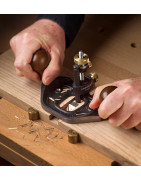
In smal and large versions all depending on the size of your work.
-
Scraping Planes
The scraping plane is the ideal tool for final smoothing — especially when you have to deal with highly figured wood or reversing grain. With a well-sharpened blade and light cuts you can achieve excellent results on any wood. Tear-out is virtually eliminated with the cutting action
-
Shootingboards
If you search for bumpers on the internet, you will find that it used to be called "Bestötlåda" and like many words in wood it comes from Germany (ty. bestosslade, bestossen) The bumper has also been called "Finishing table".
It is used together with a plane, often a jointer, to plane end grain at right angles. But also in other angles, 45,60 etc. However, if you search for the English name "shootingboard" you will get many hits! -
Shoulderplanes
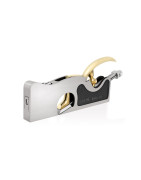
The shoulder plane is a plane tool with a blade flush with the edges of the plane, allowing trimming right up to the edge of a workpiece. Like a rebate plane, the shoulder plane's blade extends, therefore cuts, to the full width of the tool. The shoulder plane is used to trim the shoulders and faces of tenons. It is used when it is necessary to trim right into the concave corner where two surfaces of the same piece of wood meet perpendicularly. It is also commonly used to clean up dadoes (housings) and tenons for joinery.
-
Specialplanes
Specialplanes
-
Spokeshaves
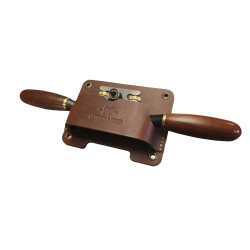
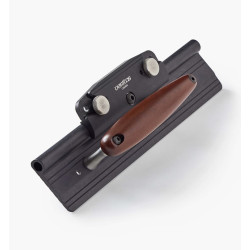
These spokeshaves are beauties, and they will quickly become favorites as they are so easy to use. All three have been designed for smooth, effective, chatterfree shaping of chair spindles, panel edges, paddles and tool handles, or other shaping.
-
Veritas Miniature Tool
Our miniatures are all fully functional 1:3-scale versions of our full-size tools – and are meant to be used. Well made and surprisingly comfortable, they are a good choice on delicate projects or where full-size tools would be cumbersome to use.
The planes, scraper and spokeshave have investment-cast stainless-steel bodies; the planes and spokeshave have A2 blades, the scraper uses a spring-steel blade, and the chisels are PM-V11 steel.
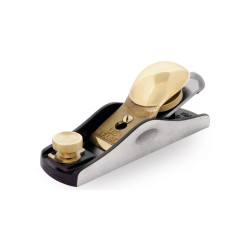
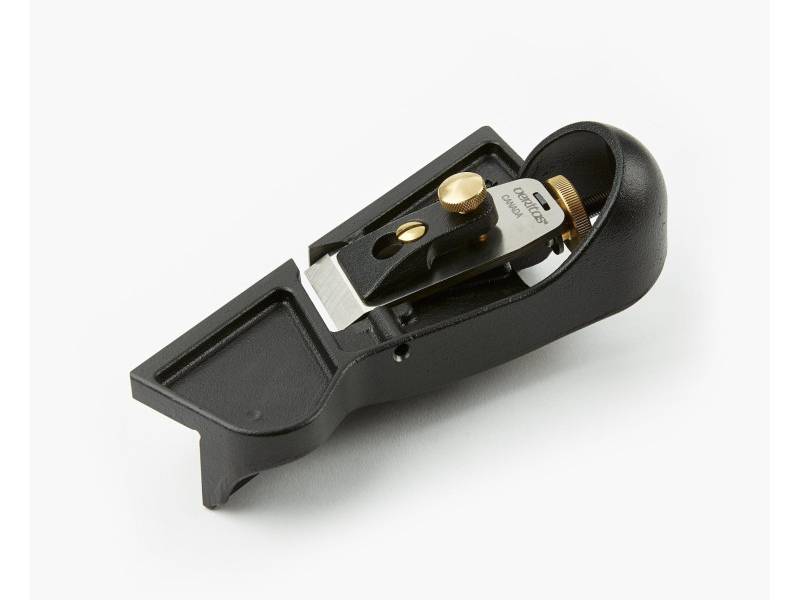
The router plane, with a blade that can be positioned inboard for standard use or outboard for true bullnose work, is ideal for hardware installation and for fine inlay or intarsia work. The shoulder, bench, low-angle block and edge planes are useful for any fine trimming work. The edge plane is suitable for stock up to 3/8" thick; the shoulder plane is also a good choice for cleaning the bottom of narrow dadoes. The plow plane cuts a 3/32" slot and has an adjustable fence.
The blade on the cabinet scraper can be cambered with a thumbscrew. The spokeshave and chisels allow a delicate touch that is particularly useful in model making. The chisel set includes 1/8", 1/4" and 3/8" blade widths.
The marking gauges (regular and dual) have a hardened steel wheel that leaves a clear mark, even on cross grain.
The honing guide has a die-cast aluminum body that rides on a brass roller and accepts blades up to 3/4" wide. It can be used for sharpening our miniature tools and other small blades.
At 7" long, the rip tenon saw has a high-carbon steel blade with an effective cutting depth of just over 1 1/4" and a nominal kerf width of 0.014". The 27 tpi ripping teeth have a 14° rake using the typical 60° included angle.
All the tools are made in Canada, and each comes in a French-fitted presentation box.
The tools are available in various sets. The complete set includes all our miniature tools described above. Each tool is also sold individually.
-
Accessories and spares
Accessories and spares for your planes.
-
Plane blades
Plane blades