

Tool advice
Which plane to start with depends on what you will do, but for most people a smoothing plane (No. 4) or a jack plane (No. 5) is a good first choice. The smoothing plane gives smooth surfaces, and the jack plane is a versatile plane for both rough work and truing edges.
Low-angle jack planes such as the Lie-Nielsen No. 62 and the Veritas low-angle jack are also popular all-round planes. A block plane is a good addition for end grain and chamfers. The guide explains how the hand plane is built and which types exist.
There are several good ways to sharpen chisels and plane irons: water stones, diamond stones, oil stones and sharpening machines such as Tormek. All give sharp edges, but they differ in speed, maintenance and price.
A honing guide makes it easier to keep the same angle every time. The most important thing is to find a method you enjoy and use often. The guide helps you choose.
Which water stone you need depends on how dull your edges are and how fine a finish you want. A common setup is a coarse stone around 1000 grit to shape the edge and a fine stone around 5000–8000 grit to polish it. For chipped edges you need a coarser stone too.
Water stones wear unevenly and need flattening regularly. The guide explains grits, brands and flattening.
A honing guide holds the tool at the right angle to the stone. A side-clamping honing guide grips the tool from the sides and suits chisels and narrow plane irons well. A top-clamping honing guide holds from the top and also handles blades with bevelled sides and unusual shapes.
Both work well, and the choice depends on the tools you have. The guide compares the types.
Japanese saws cut on the pull stroke, which lets the blade be thin and give fine cuts. A dozuki has a back and suits precise cuts such as dovetails. A ryoba has teeth on both edges, crosscut and rip, and is a versatile saw. A kataba has one toothed edge without a back and handles deeper cuts. A kugihiki is a flexible flush-cut saw for plugs.
The guide explains the differences.
Which handsaw to choose depends on the tooth pattern and the number of teeth per inch (tpi). Rip teeth cut along the grain and crosscut teeth across it. Few teeth give fast but rough cuts, and many teeth give slower, cleaner cuts.
Backsaws such as tenon saws and dovetail saws are used for precise joinery. The guide covers tooth patterns, sharpening and choosing a saw.
A shoulder plane and a rebate plane both have a blade that reaches the edges, but they are used for different tasks. The shoulder plane is narrow and precise and is used to trim tenon shoulders and adjust joints, often on end grain. The rebate plane often has a fence and depth stop and is used to cut rebates along an edge.
The guide explains when to choose which.
Planes of cast iron and steel rust easily, especially in unheated workshops and from moisture on your hands. Wipe the plane after use and protect bare surfaces with a thin layer of wax or oil that will not mark the wood.
Store your planes dry, ideally in a plane sock or box. If rust has already formed, the guide shows how to clean and protect them.
A new replacement iron can make an old plane better than it was when new. To find the right one, measure the iron's width, thickness and slot dimensions, and check whether the plane has a cap iron and what kind of adjuster it has.
A thicker iron chatters less but may require the mouth to be adjusted. The guide shows how to measure and choose correctly. You can also send us a photo of the iron with a rule beside it, and we will help you. We do not sell adjusting screws or other spare parts for old Stanley planes.
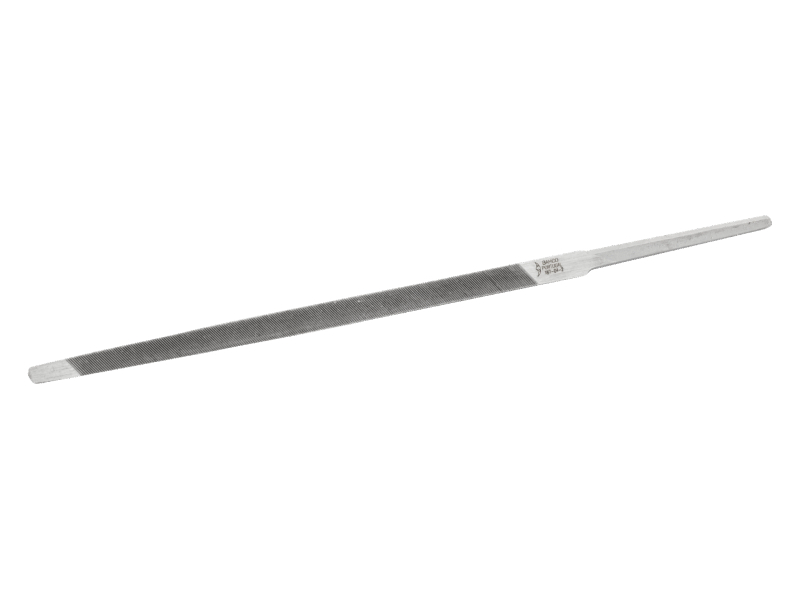
A card scraper is a thin steel plate that scrapes smooth surfaces, especially on difficult wood. It is sharpened in three steps: the edge is filed straight, honed smooth and then turned into a small burr with a burnisher. The burr is what cuts.
When the scraper stops making shavings, you can often turn the burr again with the burnisher. The guide shows it step by step.