

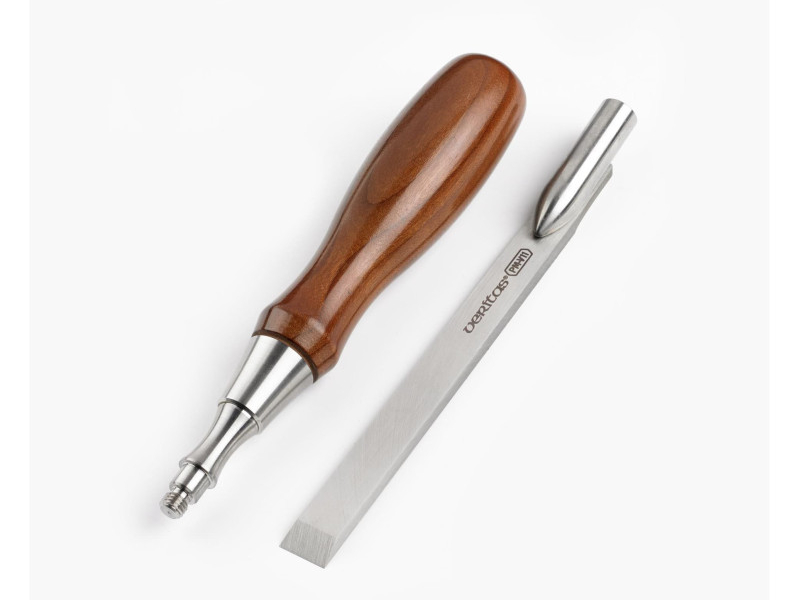

Veritas brings out new planes at regular intervals. Most recently I received a sample of their new inset plane. The plane body can either be used as it is or built into a larger plane body. I first thought I would test it myself, but instead I let Niklas, who is training as a cabinetmaker, try it, write a review and take some pictures. Below you can see how it went!
I have now had a little more time for experimenting and for writing down my observations. It has been a fun but tricky little project.
My first impression, apart from how small the plane actually is, was how well it planes. The blade was sharp straight out of the box, and the small mouth makes it an excellent little smoothing plane. I almost wondered what was wrong with my Stanley planes. I had quite a lot of fun for a while smoothing with the plane as it was, but in the long run it is too small for that. When I started building a body for it, I realised one of the drawbacks: the plane's dimensions are imperial.
The instructions you can find online suggest making the recess for the plane the same way as a mortise, by boring out a slot in stages and cleaning up with a chisel. I had trouble finding a bit of the right size, but eventually found a 1/4" router cutter. Instead of using a hand router, I made a few holes in a piece of beech with a slot mortiser (steadier than a router, but trickier to set up). My idea all along was to get the plane to stay put by friction rather than gluing it in. Gluing it with epoxy makes it something of a single-purpose plane, whereas it becomes much more flexible and useful if you can swap between different bodies. So I first made the hole slightly too short, then pared it until the plane fitted. That was not easy, and I soon had a hole that was too big. I then tried to make it fit by adding some tape in the hole, but that added too much material: the plane pushed the tape aside when I pressed it in. The top rear edge of the plane sticks out a little from the metal body, and I had hoped this would help a friction fit, but it sticks out too much, so that part does not go into the hole at all. After adjusting the slot mortiser and planing down the thickness of the wood a little, I got a better fit. The instructions say to flush the wooden sole with the metal sole after gluing. I tried to get that fit without flushing, but it turned out to be very difficult.
Around this point I also realised the plane would never stay in the hole by friction alone. In normal use it is simply pushed up out of the hole. I then used a trick (Peder's suggestion, I must admit) and drilled a hole from the back edge into the recess and screwed in a bolt to hold the plane in place. Only then did the construction become stable. To be sure the plane stays completely still, you could probably use two bolts and stabilise it at two points.
I also tried using the plane as a chamfer plane without building it in. Our latest project has been a round table with an edge-banded top. I chamfered the edge simply by holding the plane at 45° (by eye) between my thumb and index finger. Using my fingers as a fence, it worked perfectly to take it once round for a neat, discreet chamfer.
I am a bit torn about this plane. The idea is very promising, but it stands or falls on a few things. I have thought about uses other than the chamfer plane Veritas suggests, but have not had a real flash of inspiration. It would have been much more flexible if it had been designed as a shoulder plane. Even if you only make chamfer planes from it, it could be useful to have a set of bodies to fit it into for different chamfers. If you have to glue it in with epoxy for it to work, though, it is quite a lot of work to decide which chamfer you want. If the plane is cheap enough you could perhaps make several that are glued in, but then the question is whether an adjustable plane would be more useful. My lack of imagination may limit me a little. I imagine instrument makers and other specialists could use the plane for that one task nobody else can do, but I still get the feeling that it is the answer to a question nobody asked.
It must be said, though, that it is quite fun to build your own plane.
In summary
It is a well-made plane of good materials that is very pleasant to use. The fact that it is built to imperial dimensions may cause problems for us Swedes, but it is not an insurmountable obstacle. The concept is interesting, but in my opinion it rather depends on whether you think the plane should be usable for several things rather than locked to one. Hobby woodworkers will probably find it a fun build anyway, and there are surely specialists who can think of uses that a second-term fine woodworking student cannot imagine. Personally I like the idea of it as a little smoothing plane best, and for that it works really well.
Share this content
