To hone my chisels and plane irons I mostly use Japanese water stones, but sometimes also diamonds, either as stones or as paste on, for example, MDF. In this post I thought I would show my various stones and write a little about what I use them for.
Generally, stones have three uses:
– Shaping an edge on the tool. Shaping the edge on a coarse stone or on a grinder is called grinding, and shaping it more finely is called honing. When you hone an edge, the first aim is to remove the old worn edge and possibly change its shape. That may mean increasing or reducing the camber, or squaring up a chisel edge that is not quite square.
– Polishing the edge. A honed edge has fairly large scratches from the stone that must be polished out on a fine stone. The finer the polish, the sharper the edge and the longer it lasts.
– Flattening or otherwise shaping another stone. Water stones wear quickly when you hone or polish and must be flattened often – perhaps every five minutes or more often, depending on how hard you work. When I flatten the back of a new iron, I flatten the stone after about 100 strokes. When I do “normal” honing, about every five chisels or plane irons is usually right.
Diamonds
I mostly use diamonds for flattening other stones, the backs of uneven plane irons or chisels, or for really hard steels such as D2.
Among my diamond stones are a couple of special ones called “Odate Crowning Plates”, which I bought from Tools for Working Wood.
One is a concave 600-grit plate that I use to shape plane irons with a fairly pronounced camber, suitable for a jack plane, for example. For the smoothing plane the camber is a bit too strong, but it can be adjusted by taking a few strokes in the middle on an ordinary 800–1200 water stone. The other is a convex plate used to shape a water stone concave, i.e. to the same shape as the 600 plate. That concave stone is then easy to polish the edge on.
Two others are DMT Duo-Sharp plates, which I mostly use for flattening water stones. The large one is blue/red, i.e. coarse/fine, and the smaller one is black/blue, i.e. extra coarse/coarse.
You can flatten with both black and blue, but the red side has a different bond for the diamonds, so they tend to come loose if you flatten water stones with it. I try to use only the coarse sides for stones, but sometimes they have to step in and flatten a plane iron or chisel too.
I also have a coarse/fine stone that I use for all kinds of knives and the like. Handy when you do not want to make a mess with water stones.
In addition I have three syringes of diamond paste. I use it by putting a few drops on a piece of MDF and using that as a stone to polish the edge when I want an extra high polish. The finest paste is 0.25 µm, finer than my 12000 stone. For D2 steel, diamond paste is necessary to get the best sharpness. On the other hand, the edge lasts a very long time before it needs honing again.
Medium and coarse water stones
Water stones can be divided into coarse, medium and fine. Medium is about 800–2000, coarse is coarser than 800 and fine is finer than 2000. Among my medium stones are three King stones of 800, 1000 and 1200 grit, and a Naniwa Super Stone of 800 grit. I like the Naniwa best, as it holds its shape a little better than the corresponding King and still cuts at least as fast. It also has more of that hard-to-define “feel” that lets you sense how it is cutting and whether you need to change the pressure on the stone. A pencilled tick on the stones means they have been flattened and not yet used.
I also have a 220-grit Shapton stone that I sometimes use to regrind a damaged edge or to flatten a back that needs a lot of work.
Fine water stones
My finest stones are the ones I use to polish the edge to its final sharpness and finish. They include a King 8000 and a King 10000. The finer stone has a concave surface from the Odate plate. I often use this pair together with the concave diamond plate to quickly get a sharp edge on my jack planes or other planes meant for slightly thicker shavings, where the demands on the surface are not the very highest. The finer stone polishes the edge and the 8000 stone the back.
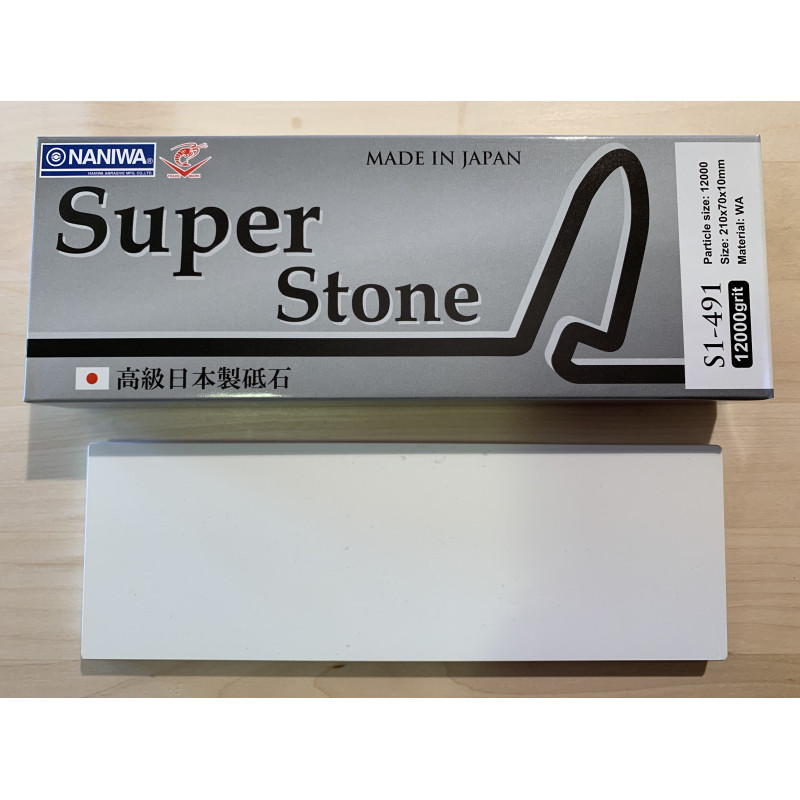
I also have a King 4000, which I often use as an intermediate stone for chisels and smoothing plane irons, as well as a Naniwa Super Stone 8000 and an NSS 12000, which give a perfectly polished edge with good sharpness and durability. Usually I settle for polishing to 8000, but going all the way to 12000 does make a difference. You often see the recommendation to roughen the surface of the finer stones with a so-called nagura, but I have stopped doing that as I have not seen any benefit at all. It just gets even messier.
Accessories
I also have some accessories I use for honing plane irons and chisels. There are two screwdrivers, a Lie-Nielsen and a Lee Valley, which I use to loosen and tighten cap irons and to tighten the honing guides. It is important to have a screwdriver that fits the cap iron screw, as it is often quite soft and easily damaged by a screwdriver of the wrong size.
I also have several honing guides: an Eclipse “original” and two Chinese copies. They are what I use for 95 % of my honing. On one of the copies there is a Lee Valley holder for short irons, which I use for, yes, short irons. A clever design where the iron is held by an angled edge and a couple of strong magnets. I also have a Veritas honing guide that comes out on special occasions, such as when the edge is to be skewed or if the blade does not fit the Eclipse guide. The guide comes with a cambered roller, a straight roller, a setting jig for skewed edges and a setting jig for straight edges. That is a lot of parts… I always use the cambered roller, because the straight one controls too much and does not let me influence the result enough, for example to hone a slight camber on the iron. The straight roller gives a false sense of security when you want a straight edge square to the sides. Unless you manage to set the iron absolutely straight and have an absolutely flat stone, the guide will automatically produce a skewed edge. With an Eclipse guide, or with the cambered roller, you can easily shape the edge the way you want it by varying finger pressure. I also find the Veritas guide both expensive and unnecessarily complicated to use. It gives no better results than the cheap one after a little practice.
Finally, I have a thin steel ruler that I use both to set the irons in the honing guide and for David Charlesworth’s “ruler trick”. In short, it involves placing a ruler under the iron on the far side of the stone so that only the very tip of the back, nearest the edge, gets polished. It saves a lot of time and effort. I use the trick on all plane irons, except on my Wayne Anderson smoothing plane, and on all card scrapers and scraper plane blades, but never on my chisels.
Swedish glossary: waterstone = vattenbryne, grind = slipa, hone = bryna, polish = polera, honing guide = slipstöd, brynstöd.
Share this content