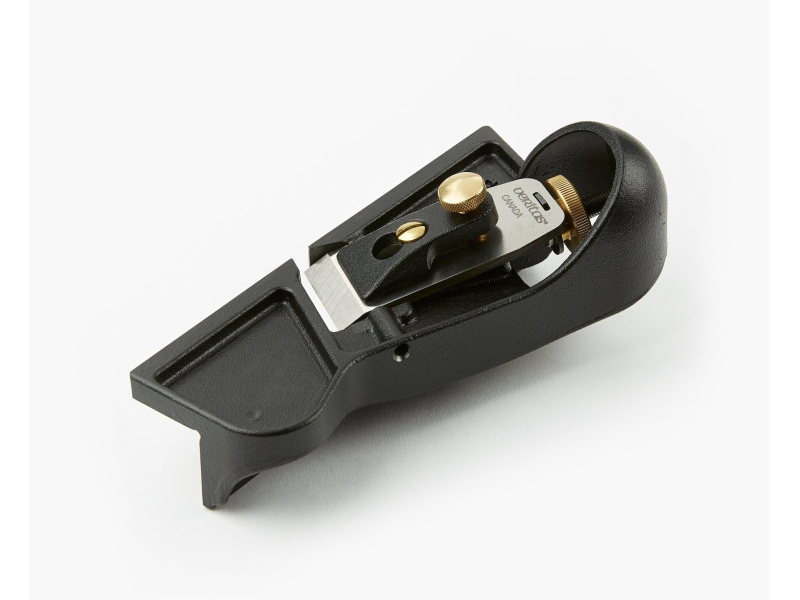


3/16" tongue-cutting blade for the Veritas small plow plane and combination plane.
3/16" tongue-cutting blade for the Veritas small plow plane and combination plane.
Used for tongue-and-groove work, the interchangeable blade system enables you to cut six different tongue widths (grooves are cut with matching sizes of the standard blades) to support stock of varying thicknesses, all using the same plane.
Each A2 cutter has an integral depth stop and shaving deflector. The cutters are usable with both the right- and left-hand plow planes, and can be used with the combination plane for both right- and left-hand work. For the small plow plane, a wide-blade conversion kit is needed to use any of the tongue-cutting blades. These narrow tongue sizes are particularly well suited for the thinner stock used in cabinetry and drawer carcass construction. All blades have a 35° bevel angle. Made in Canada.

Specific References
Yes, much of what you do with a router can be done with hand planes, quietly and without dust:
Router plane – flat bottoms in recesses, housings and inlays
Plough plane – grooves along the grain
Shoulder plane and rebate plane – rebates and tenons
Hand tools come in fewer sizes than router bits, so you have to adapt the dimensions to the blades available. In return you get full control and can work anywhere.
There are several good ways to sharpen chisels and plane irons: water stones, diamond stones, oil stones and sharpening machines such as Tormek. All give sharp edges, but they differ in speed, maintenance and price.
A honing guide makes it easier to keep the same angle every time. The most important thing is to find a method you enjoy and use often. The guide helps you choose.
Planes of cast iron and steel rust easily, especially in unheated workshops and from moisture on your hands. Wipe the plane after use and protect bare surfaces with a thin layer of wax or oil that will not mark the wood.
Store your planes dry, ideally in a plane sock or box. If rust has already formed, the guide shows how to clean and protect them.
A new replacement iron can make an old plane better than it was when new. To find the right one, measure the iron's width, thickness and slot dimensions, and check whether the plane has a cap iron and what kind of adjuster it has.
A thicker iron chatters less but may require the mouth to be adjusted. The guide shows how to measure and choose correctly. You can also send us a photo of the iron with a rule beside it, and we will help you. We do not sell adjusting screws or other spare parts for old Stanley planes.
Most products are restocked on an ongoing basis, but delivery times from the manufacturer vary. When an item is out of stock, the button Notify me when available appears on the product page.
Click the button and enter your email address, and we will email you as soon as the item is back in stock. If you are logged in, your email address is registered automatically. If you want to know when the next delivery is expected, you are welcome to contact us.
How often items are restocked depends on the supplier. We receive deliveries from Veritas about once a month, Lie-Nielsen ships in batches and we order from Incra about once a year. You can also add the item to a wishlist in your account, where you can see whether it is in stock.
3/16" tongue-cutting blade for the Veritas small plow plane and combination plane.