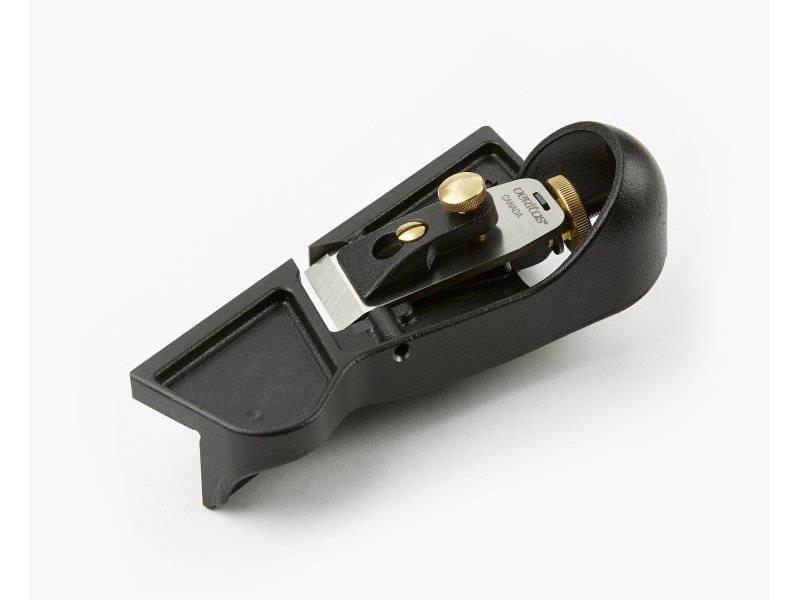


Veritas Combination Plane. While combination planes are defined by their flexibility (Stanley boasted that their #45 was seven planes in one), they are not complex to use and are often faster to set up than a machine for one-off work.
While combination planes are defined by their flexibility (Stanley boasted that their #45 was seven planes in one), they are not complex to use and are often faster to set up than a machine for one-off work.
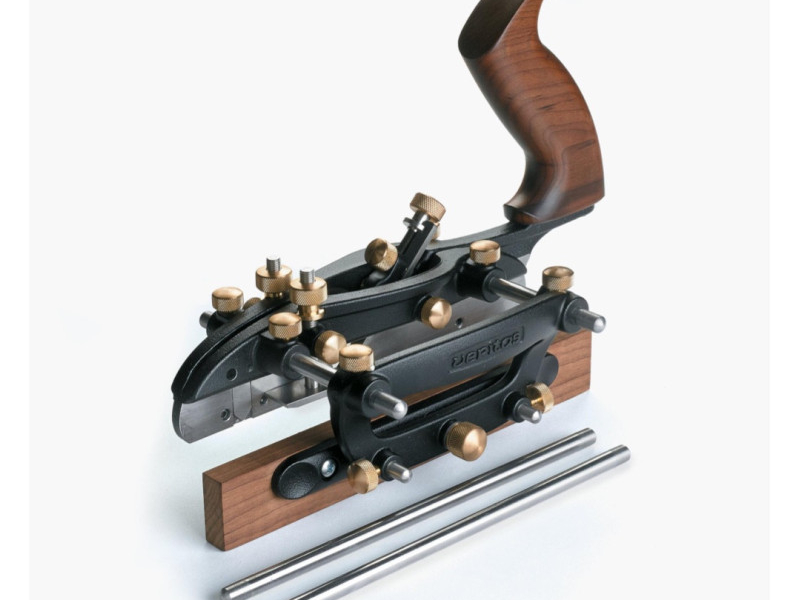
The Veritas combination plane was designed from the ground up to eliminate problems that made the original Record and Stanley planes frustrating to use. It is precisely machined, quick to adjust and holds settings securely. With straight cutters used in conjunction with the fence, it can tackle fundamental joinery such as rabbets, tongues and grooves, and with a shop-made batten it can also cut through-dadoes.
The two-part design, with a main body and a separate sliding section, accommodates blades of different shapes and sizes for cuts ranging from grooves as narrow as 1/8" up to 1" wide rabbets. To prevent tear-out in cross-grain work, adjustable scoring spurs on both the main body and sliding section define the edges of the cut ahead of the blade.
The sliding section adds stability and support to the blade, and clamps securely on stainless-steel rods. The fence can be positioned on either side of the plane for left- or right-hand use or to accommodate grain direction. Two pairs of rods are included, 5" and 8" long, for cuts reaching up to 5" from the edge. The torrefied maple fence face can be fine-tuned with a micro-adjust thumbscrew, and the depth stops have threaded adjustment.
A 1/4" straight blade is included, and blades for grooving, rabbeting, beading, reeding and fluting are available separately. The 45° blade bed also holds any of the right-hand blades for the Veritas small plow plane. The position of the blade adjuster prevents left-hand-only blades (1/8" to 3/8" and 4 mm to 10 mm) from being used, but the reversible fence lets you use the right-hand blades for both right-hand and left-hand cuts. It also accepts Record 405 and Stanley 45/55 blades, used individually or in sequence to create profiles from furniture edge treatments to architectural details.
The plane is 10 1/2" long and weighs 4 lb. Made of stress-relieved ductile iron with brass fittings and a torrefied maple tote. Made in Canada.

Specific References
Which plane to start with depends on what you will do, but for most people a smoothing plane (No. 4) or a jack plane (No. 5) is a good first choice. The smoothing plane gives smooth surfaces, and the jack plane is a versatile plane for both rough work and truing edges.
A block plane is a good addition for end grain and chamfers. The guide explains how the hand plane is built and which types exist.
A shoulder plane and a rebate plane both have a blade that reaches the edges, but they are used for different tasks. The shoulder plane is narrow and precise and is used to trim tenon shoulders and adjust joints, often on end grain. The rebate plane often has a fence and depth stop and is used to cut rebates along an edge.
The guide explains when to choose which.
Planes of cast iron and steel rust easily, especially in unheated workshops and from moisture on your hands. Wipe the plane after use and protect bare surfaces with a thin layer of wax or oil that will not mark the wood.
Store your planes dry, ideally in a plane sock or box. If rust has already formed, the guide shows how to clean and protect them.
Most products are restocked on an ongoing basis, but delivery times from the manufacturer vary. When an item is out of stock, the button Notify me when available appears on the product page.
Click the button and enter your email address, and we will email you as soon as the item is back in stock. If you want to know when the next delivery is expected, you are welcome to contact us.
You might also like
Veritas Combination Plane. While combination planes are defined by their flexibility (Stanley boasted that their #45 was seven planes in one), they are not complex to use and are often faster to set up than a machine for one-off work.