The Plane Doctor has been left fallow for a while because of intrusive reality, but now I'll try to catch up. For example, I will fearlessly enter the “hen” debate. (In Swedish, “hen” is the new gender-neutral pronoun – and, as everyone knows, also a perfectly usable old word for a whetstone.) So don't be alarmed if you are urged to flatten your hen with diamonds or if a Japanese water hen is put to use…
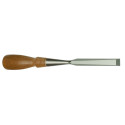
Speaking of hens: I have amused myself by comparing the results of honing two identical 12 mm Lie-Nielsen chisels in two different ways. Number one on oil stones and number two on my new Sigma Power Ceramic, that is, Japanese ceramic hens.
I bought a set from Stu in Japan and am very pleased with them. Besides the stones, the set includes a really good diamond hen, a hen holder and a plastic tray. The holder and the tray solve two of the problems with water hens: the stones stay put, and the slurry is kept in place.

Chisel 1 was honed at 35 degrees on my oil stones, finishing with green polishing compound on a strop.
Chisel 2 was honed at the same angle on the Sigma stones in the sequence 1000–6000–13000.
As expected, there was no difference in the result. A test in the end grain of a piece of pine shows that both edges are equally sharp and make clean, neat cuts. This is a good test, as you immediately see the quality of the edge in the cut. A sharp edge leaves a surface that is shiny with no tool marks. A less than perfect edge leaves a surface that is dull and scratched. It is best to do the test in softwood, since its soft structure places higher demands on a sharp edge to cut cleanly.
My impression is that it takes a little longer to get the edge sharp on the oil hens, but they are less messy and you don't need to flatten them as often. The feel is very good and they are always ready to use. Just squirt on a little oil and hone. Water stones, on the other hand, must be soaked for a while before they are ready to use. Sigma Power stones are hard and cut fast, which means they hold their shape well and don't need much flattening. I usually give them a couple of strokes with the diamond stone before I use them and between each tool. It helps keep them flat and gives a nice fresh surface.
Share this content