Back again after a bit of Christmas holiday! Now that the workbench build is finished, things will be more about planes again. And rasps. And saws. And…
A basic technique for planing end grain in particular is to use a shooting board. I keep mine within easy reach under the workbench so that I can quickly pull it out to square up a piece I have sawn. At the same time I automatically get a neat piece with polished end grain. A shooting board can look many ways, but it is basically a platform with a fence at right angles to the planing direction. The fence should be as close to 90 degrees as possible, but if it is not perfect you can always shim with a bit of paper, an old business card or similar between the workpiece and the fence. If you place the shim close to the plane, the angle of the planed end increases, and if you place it far from the plane, it decreases. Being exact is of course best, but if the shooting board is made of wood it will change shape somewhat with seasonal movement. ALF has some good links on her website with different designs for anyone who wants to build their own. You can also quickly nail together a few pieces from the scrap bin!
Most plane models work well on a shooting board, but it is an advantage if the plane has a good weight, a fairly long sole and feels good to hold. A solid jack or jointer plane like my hundred-year-old Stanley Bedrock #8 is excellent, but any model from #5 upwards is good. Many people are also happy with a low angle jack plane from Lee Valley or Lie-Nielsen. I have tried both and think they work well, but they offer a little less room to grip than a Bailey-pattern plane. For thin mouldings and small parts everything can be scaled down and you can use a small block plane. Some important things to keep in mind are to keep the iron sharp as always, to keep steady downward pressure so the plane does not tip, and to hold the workpiece firmly. A low cutting angle gives a certain advantage on end grain but is not nearly as important as product descriptions, forum posts and blogs would have you believe. A sharp iron is crucial; the rest is details.
A really nice plane to use on a shooting board is the Lie-Nielsen #9. It is a so-called mitre plane and has a good shape with a low centre of gravity and square sides. It also has enough weight to work well even in harder woods.

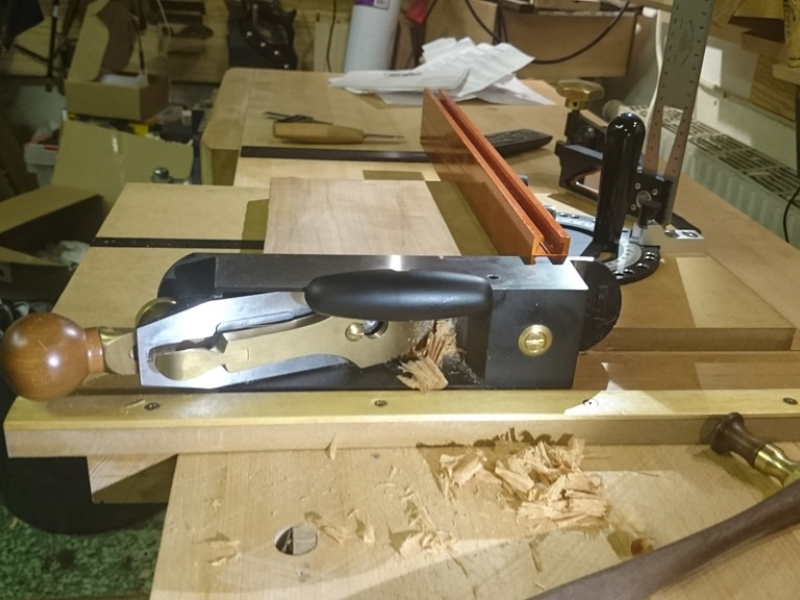
My favourite plane for shooting is a Lie-Nielsen #51 Chute Board Plane, which is designed solely for this purpose. It runs in a small track on the shooting board, so you only need to push the plane back and forth for it to do its job. You don't have to think about holding it against the edge without tipping it, which you otherwise must. I bought the plane second-hand from my friend Chris when I visited the USA last autumn. He has written about his impressions of it. Apparently he changed his mind after publishing…
For anyone who really wants to dig into the details, David Charlesworth's second book and his DVD on shooting boards are recommended. Like everything else he has published, they are a goldmine of information.
Share this content