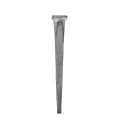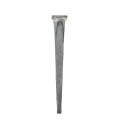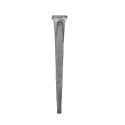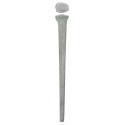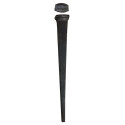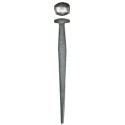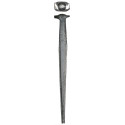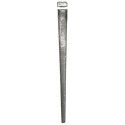
What is a cut nail?
Cut nails are sheared cold from a strip of iron or steel, and the head is then formed in a press. The process made mass production of nails possible. In the early 1700s Christopher Polhem built a nail-cutting machine in Sweden, and cut nails were common until wire nails took over around 1900.
Our cut nails come from Tremont Nail Company in Massachusetts, USA, which has made nails since 1819. The nails are still made on machines from the 19th and early 20th centuries, so head shape and length can vary slightly from nail to nail, just like old nails.
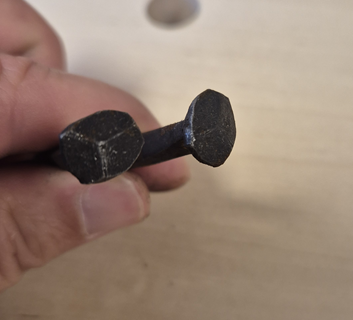
Why do cut nails hold so well?
The nail has the same thickness all the way but tapers in width towards the point, like a wedge. When driven, the wedge pushes the wood fibres aside and is gripped by them, rather than just slipping in between them like a round wire nail. That is why cut nails hold very firmly, and they can be straightened and reused.
Why is the size called 8d?
In the USA and on Tremont nails, length is often given in "penny", written with a d: 6d, 8d, 10d and so on. The system comes from 15th-century England, where nails were sold by the hundred. An 8d nail was a nail that cost eight pence per hundred. Longer nails cost more, so the price became a measure of size. The letter d comes from the Roman coin denarius, the abbreviation for penny in the old British currency.
Prices have of course changed since then, but the names stayed as size designations. From 2d to 10d the length increases by a quarter inch for each step.
| Penny | Length (in) | Length (mm) |
|---|---|---|
| 2d | 1" | 25 |
| 3d | 1 1/4" | 32 |
| 4d | 1 1/2" | 38 |
| 5d | 1 3/4" | 44 |
| 6d | 2" | 51 |
| 7d | 2 1/4" | 57 |
| 8d | 2 1/2" | 64 |
| 9d | 2 3/4" | 70 |
| 10d | 3" | 76 |
| 12d | 3 1/4" | 83 |
| 16d | 3 1/2" | 89 |
| 20d | 4" | 102 |
| 30d | 4 1/2" | 114 |
| 40d | 5" | 127 |
| 50d | 5 1/2" | 140 |
| 60d | 6" | 152 |

In our shop the penny size, inches and millimetres are all in the product name, and you can filter on them in the category.
The nail types and what they are for
Common nails and common rosehead nails are used for framing, rough carpentry, floors, panelling and doors. Clinch rosehead nails have a button-shaped head and are soft enough to clinch easily. Boat nails are used in boatbuilding, often where the nail will be clinched. Flooring nails are for blind-nailing floorboards. Fine finish nails, headless brads and round-head brads are for architraves, mouldings, cabinets and furniture where the nail should show as little as possible. Box nails are slimmer and suit boxes and thinner stock. Shingle, sheathing, siding and slating nails are for roofs and walls. Fire door clinch nails and hinge nails are made to be clinched on the back. Decorative wrought head nails have a head that looks like a hand-forged nail. Cut spikes, masonry nails and foundry nails are the heaviest types, for heavy construction, masonry and formwork.


Finishes
Standard nails are untreated and suit indoor use. Hot-dip galvanized nails are dipped in zinc after cutting and are recommended outdoors. Black oxide nails have a black finish that imitates oil-dipped forged iron. Hardened nails (masonry nails) are heat-treated so they can be driven into mortar and brick.
How to use cut nails
Turn the nail so that its wide side, the one that tapers towards the point, runs along the grain. Driven across the grain, the nail acts as a wedge and splits the wood. Tremont recommends drilling a small pilot hole for nails longer than 1 1/2" (38 mm). Cut nails bend without breaking, so they can be clinched on the back, which makes the joint much stronger.

See our range: Cut Nails
Share this content