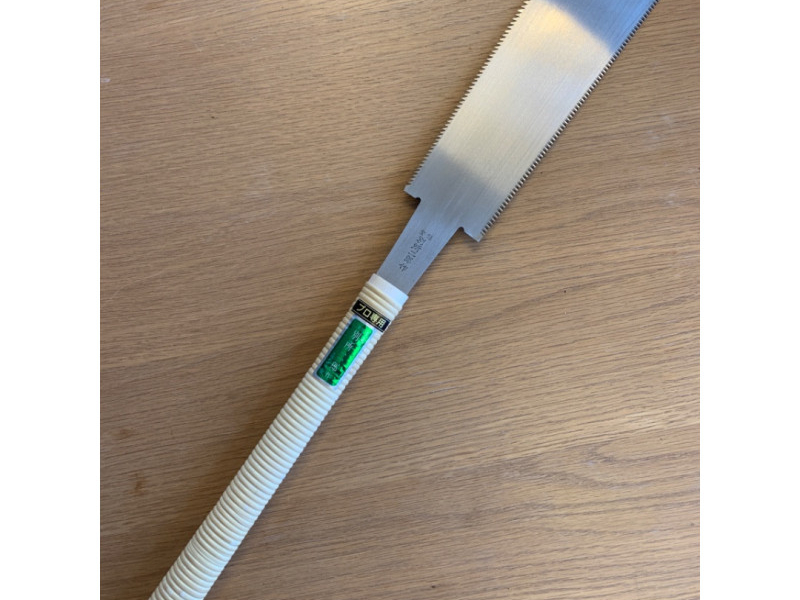


Hishika kugihiki saw, 180 mm. It features a handmade saw blade hardened one at a time by hand, as has been done traditionally in Japan for centuries. The whole blade is hardened for flexibility as well as hardness.
Hishika kugihiki saw, 180 mm. It features a handmade saw blade hardened one at a time by hand, as has been done traditionally in Japan for centuries. The whole blade is hardened for flexibility as well as hardness. The blade thickness tapers towards the back to produce friction-free strokes and the teeth are sharpened with no set to produce the cleanest cuts.
Kugihiki saws are intended for flush cutting of pins and similar applications, and have a crosscut tooth configuration. The blades are quite fragile and should not be used in applications that might over-stress them, such as cuts that are more than about half an inch in depth, except in very thin stock. Because of the way that the blade is tempered, it will break if too much stress is put on the blade. This is only an issue if the saw is used in a way for which it was never intended.
Saw type: Kugihiki (Japanese flush-cut saw)
Data sheet
Specific References
Which handsaw to choose depends on the tooth pattern and the number of teeth per inch (tpi). Rip teeth cut along the grain and crosscut teeth across it. Few teeth give fast but rough cuts, and many teeth give slower, cleaner cuts.
Backsaws such as tenon saws and dovetail saws are used for precise joinery. The guide covers tooth patterns, sharpening and choosing a saw.
You might also like
Hishika kugihiki saw, 180 mm. It features a handmade saw blade hardened one at a time by hand, as has been done traditionally in Japan for centuries. The whole blade is hardened for flexibility as well as hardness.