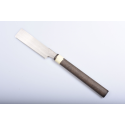


We now have Japanese saws in our range too. For some years they have been popular with both DIYers and fine woodworkers. We are starting a new category, Japanese saws, where you will find mini saws, dozuki saws and a kugihiki saw for trimming plugs or reaching into tight spaces. Like all Japanese saws, they are thin, often have impulse-hardened teeth and the distinctive tooth pattern typical of these saws.
Japanese saws cut on the pull stroke. Use light pressure on the pull and none on the return stroke.
The teeth differ from those of European saws and are very efficient while leaving a fine cut.
It is possible to sharpen a Japanese saw, but it is difficult because the teeth have a different geometry with three cutting bevels. That is what makes a Japanese saw cut straight and cleanly.
Some people prefer Western backsaws for dovetailing, for example, because a Japanese saw pulls the sawdust towards you and covers any layout lines.
Share this content