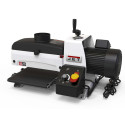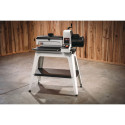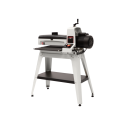
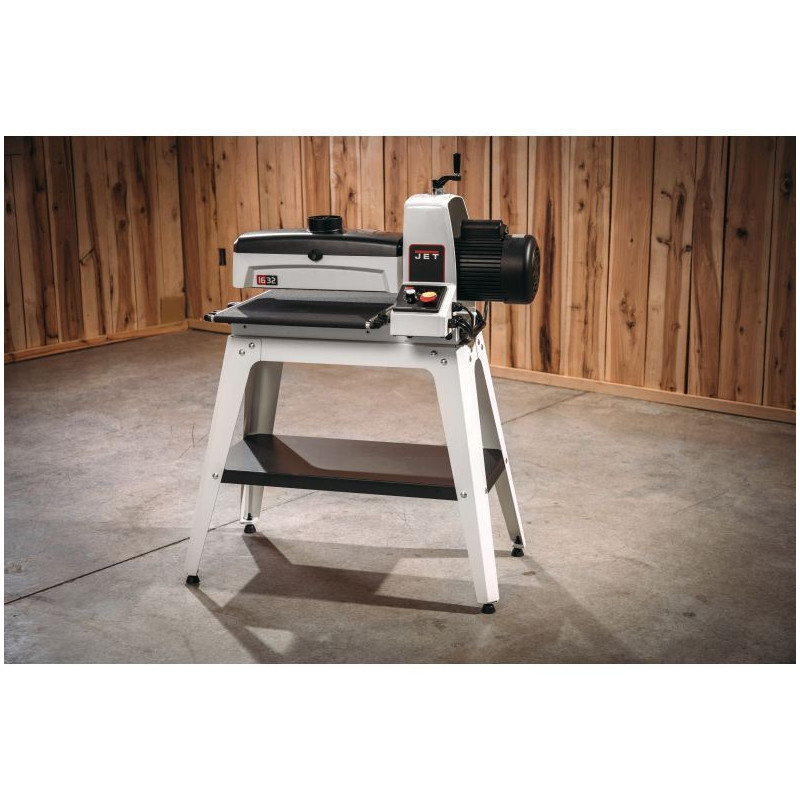
A drum sander sands boards, panels and frames to an even thickness and a flat surface. It is useful where a thicknesser tears out, for example on figured wood, thin stock and glued-up panels.
How a drum sander works
The drum is wrapped with abrasive in the grit the surface requires. The workpiece is fed automatically under the drum on a conveyor, giving even sanding and a flat surface.
The machines come with an open stand or an integrated storage cabinet.
Open end – twice the width
JET drum sanders have an open end. That means you can sand workpieces twice as wide as the drum by turning them and making a second pass. A sander with a 254 mm drum handles 508 mm, and one with a 406 mm drum handles 812 mm.
On the larger models the feed rate is infinitely variable, and SandSmart monitors the load on the drum motor and adjusts the feed automatically to avoid overload.
What it is used for
Panels, tabletops and doors
Frames and glued-up panels
Thin stock that is hard to plane
Figured wood that tears out in a planer
Which drum sander should I choose?
Compact
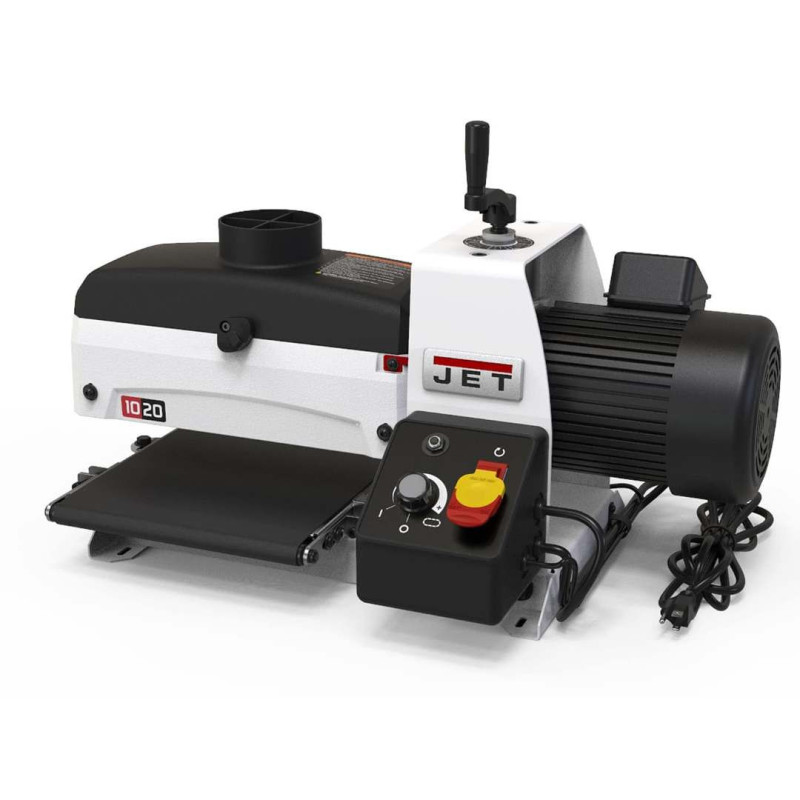
254 mm drum, 508 mm in two passes.
JET JWDS-1020
Larger
406 mm drum, 812 mm in two passes, SandSmart.
JET JWDS-1632
Drum sander or thicknesser?
How thin can I sand?
Do I need dust extraction?
See the full range: Power Tools
Share this content