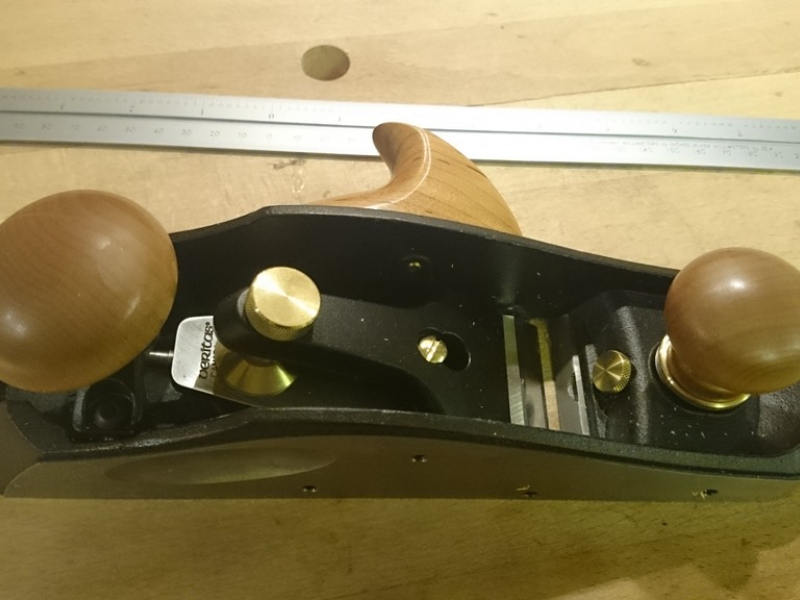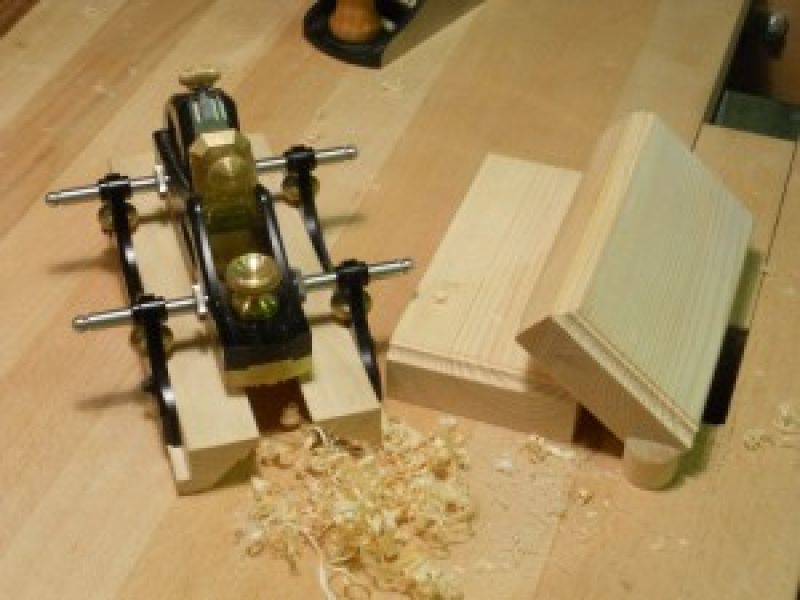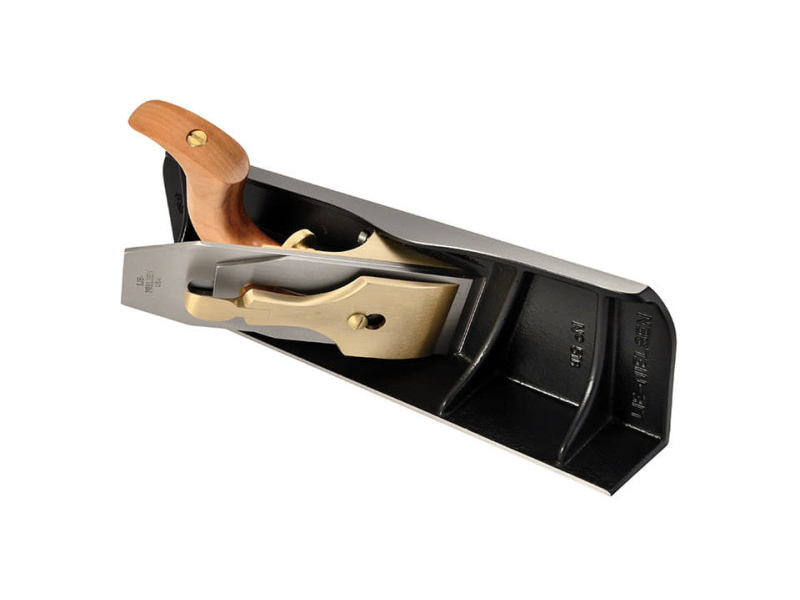
I'm sitting looking through my old posts and see that I have hardly written anything about block planes! Strange, since hardly a day goes by in the garage without my using one. I have a few to choose from, but most often it is my Lie-Nielsen 60½ that comes out. It has everything: a low angle, an adjustable mouth, the right weight and balance, and it is very good-looking too. It is the left one of the planes with a brass lever cap.
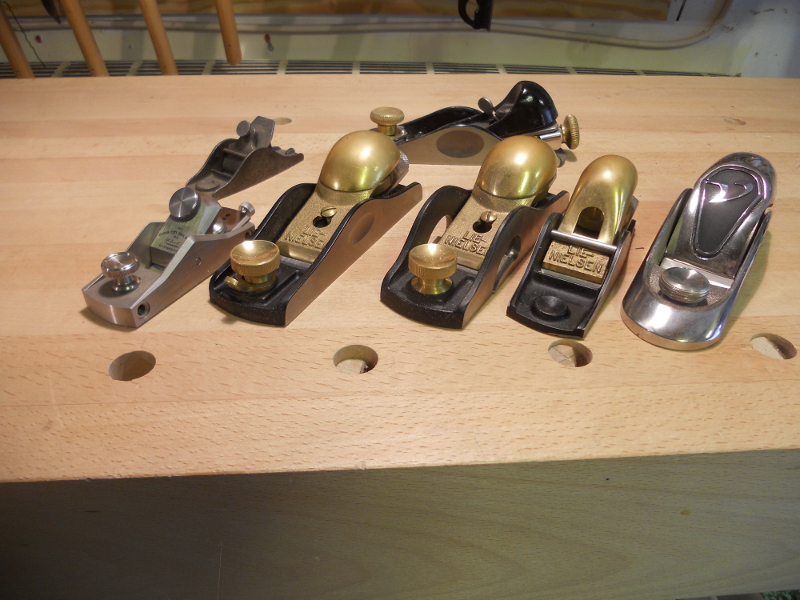
The other two Lie-Nielsen planes are the little 102, which is great for one-handed planing of narrow edges and other things that need tidying up, and a rabbet block plane, LN 60½R.
The latter is a sensitive fellow. If you clamp it too hard, the part under the iron will be pushed down and the sole deformed. What is more, when the plane is made the sole is ground flat without the iron in place. This means you have to flatten the sole a little on a new plane. It is quite easy. Put everything in place, tighten the iron to the right “working tension” and flatten on sandpaper on a flat surface. I have marked the tensioning wheel with a permanent marker so that I can find my way back to the right tension if I have taken the iron out to hone it.
The two “bling-bling” planes at each end of the picture are, on the left, a Bridge City Toolworks HP8 in stainless steel and a nickel-plated Veritas NX60. Despite its small size, the BCTW plane has an adjustable mouth and can be fitted with different fences for 45 and 90 degrees. Nice! The Veritas plane has a really handsome design and is a fantastically good plane. I do have two small problems with it, though. First, it is a little too big and heavy to sit comfortably in the hand, and second, the iron has a shape that makes it hard to clamp in a honing guide. I know, first-world problems of the highest order!
The other two planes are Stanleys, an old 101 and a new 60½. Old is better than new. The new one has a Hock iron, which makes it almost usable, but the poor clamping mechanism together with the small bearing surfaces for the iron means it hardly stays put but vibrates easily and gives what is called “chatter”. Whatever that might be in Swedish?
Share this content