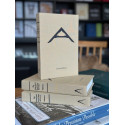
The heading is a quote from my dear father. I suppose I didn't really believe it until I tried a real rasp, that is, a hand-stitched rasp from Auriou. What a difference from the machine-made, half-dull things I had tried before! Admittedly, they can remove some wood and help roughly shape a piece in the direction you want, but the surface ends up terribly ugly, with tear-out and marks from the rasp's teeth. There are two main reasons for this: the rasp is far too coarse for fine woodworking, and the teeth sit in perfect rows one after the other. A hand-stitched rasp has finer teeth, or a finer grain as it is called, and its teeth are placed slightly irregularly. A human hand, thankfully, does not have the same regular precision as a machine.
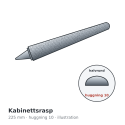
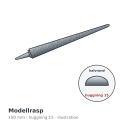
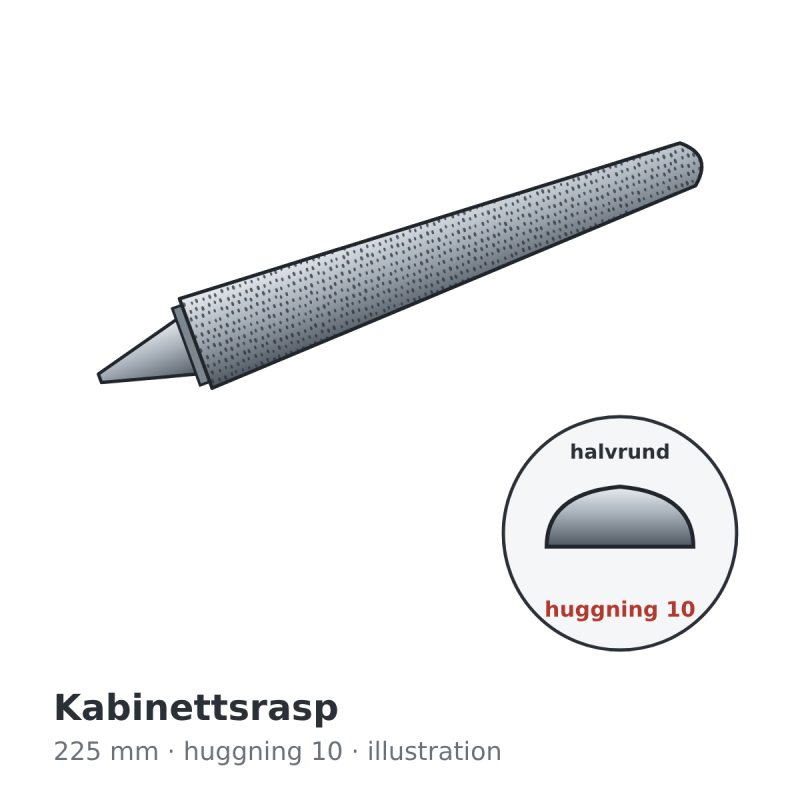
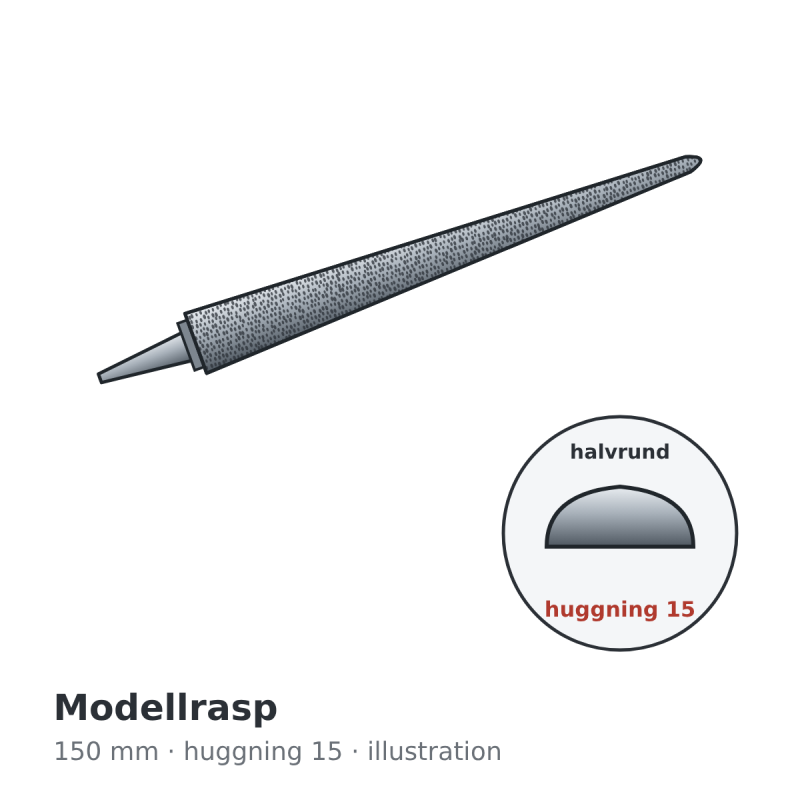
Rasps come in grains 1 to 16, where anything coarser than 5–6 is too coarse for woodworking. A sensible set is a cabinet rasp in grain 9–10 and a modeller's rasp in grain 14–16, plus a fine round rasp, a so-called rat-tail. I have two cabinet rasps in grain 9 and 10 respectively, and a modeller's rasp in grain 15 from Auriou.
Making these rasps is a craft that takes time to learn. This video shows a hand-stitched rasp being made at Liogier.

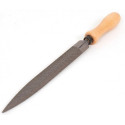
In addition to my own rasps, I have borrowed a coarser rasp, grain 7, from the maker Liogier for evaluation. I have nothing but good things to say about it. Both Auriou and Liogier make hand-stitched rasps of the highest quality. They are a joy to use, and I hope the following example shows that a rasp really can be a precision tool for shaping curves and other irregular forms. Comparing the two makers, I can say that the quality of the rasp itself is at the same high level for both. I find Liogier's handle a little clumsier than Auriou's, but it still sits quite well in the hand. As with much else when choosing hand tools it is a matter of taste, but I prefer Auriou's slightly slimmer handle. The finish is also a little better on the Auriou than on the Liogier, which has a slightly plasticky feel in the hand. I have not tried Liogier's finer rasps, so they may well have smaller handles. Even so, I would recommend both makes equally strongly. The choice probably comes down mainly to price and availability.
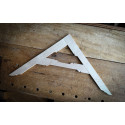
As an example I'll take a detail on a square I have been working on for a while. I started it when I was on a saw course in Germany last spring but haven't got round to finishing one until now. Schwarz fans would recognise it from, for example, the cover of “The Anarchist's Tool Chest”. I have drawn the pattern and roughly sawn away some of the waste with a coping saw. The vertical cuts I of course sawed with a backsaw.
The first step is to rasp roughly to the layout line with the coarse grain 7 rasp. I hold the rasp by taking the handle in my right hand and the tip between the thumb and index finger of my left hand. I make sure to rasp at an angle up from the line, first from one direction and then from the other. In other words, I try to make the surface higher in the middle to begin with. I can then take the middle down towards the edges a little with the coarse rasp before refining the surface with the finer rasps. For the convex surface I use the flat side of the rasp, and for the concave one the rounded side. If you let the rasp “roll” over the concave surface, you can make it follow the shape well.
The surface is already quite good with the grain 10 cabinet rasp. I take the middle of the surface down almost to the lines but save a little for the finest modeller's rasp.
Finally I clean up the surface as much as possible with my finest rasp, the grain 15 modeller's rasp. The thin blade also makes it possible to get close to the square cuts and get neat transitions. A little sandpaper finishes the job and makes the surfaces smooth and even.
Share this content