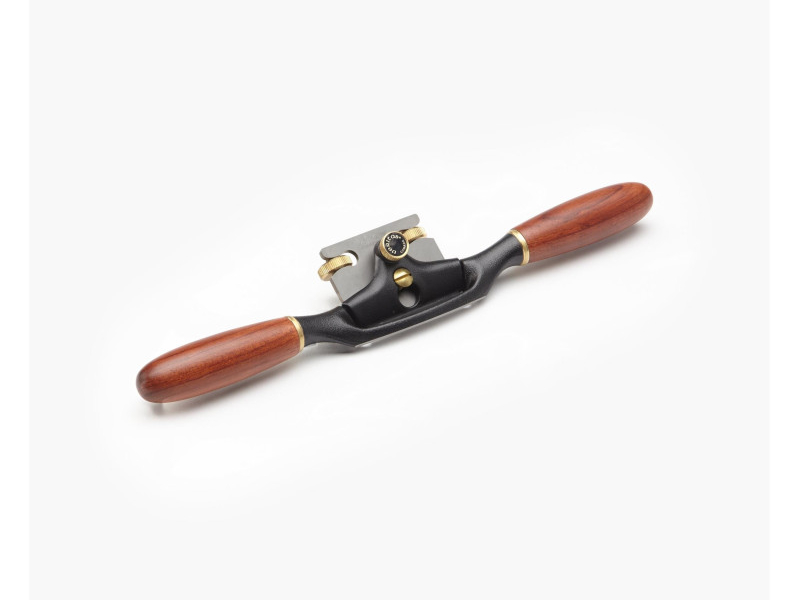


Veritas Low-Angle Spokeshave, PM-V11. Until about 1900, most spokeshaves had wooden bodies and hand-forged low-angle blades that fit into holes in the body and were adjusted by tapping the ends of the tangs. They cut beautifully due to the low cutting angle, but the blades were not easy to adjust.
Until about 1900, most spokeshaves had wooden bodies and hand-forged low-angle blades that fit into holes in the body and were adjusted by tapping the ends of the tangs. They cut beautifully due to the low cutting angle, but the blades were not easy to adjust.
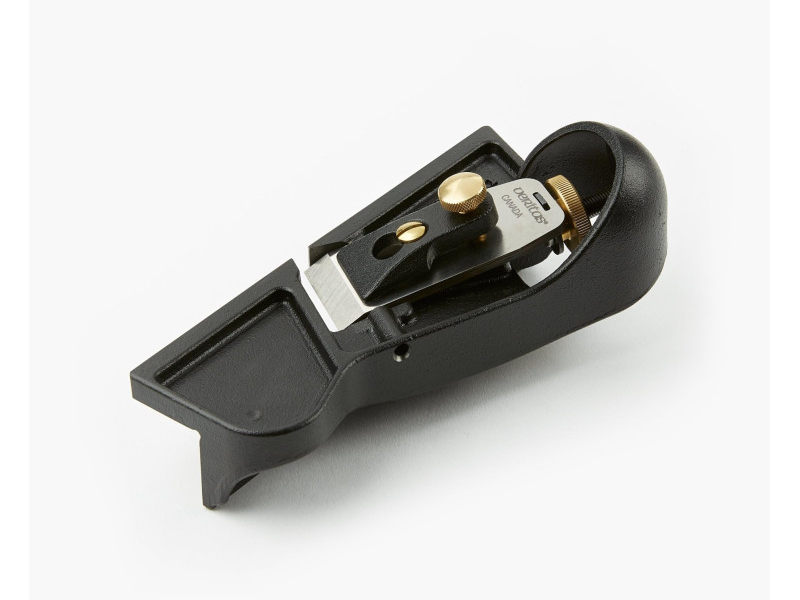
This spokeshave has the same low cutting angle as spokeshaves of old (20° basic bevel with a 25° micro-bevel), but adjustment of cutting depth has been simplified substantially. The blade is fixed, forming the sole, while the adjustable toe piece controls the depth of cut. In one orientation, the toe piece is suited to convex and flat work; flipped 180°, it is set for concave work. The blade is fixed by two machine screws that wedge it in position when the knurled knobs on top are tightened. Because the blade can be moved forward or backward, the mouth opening is controllable.
The cast aluminum body is powder coated and the tool weighs just over 6 oz. The ease of cutting and the ergonomically shaped body make it capable of much more precise work than standard spokeshaves of today. A beautiful tool with classic origins. Made in Canada.
Facts:
PM-V11 blade, 2" wide and 1/8" thick
20° bevel with 25° micro-bevel
Adjustable toe for flat, convex and concave work
Weight just over 6 oz

Data sheet
Specific References
Which plane to start with depends on what you will do, but for most people a smoothing plane (No. 4) or a jack plane (No. 5) is a good first choice. The smoothing plane gives smooth surfaces, and the jack plane is a versatile plane for both rough work and truing edges.
Low-angle jack planes such as the Lie-Nielsen No. 62 and the Veritas low-angle jack are also popular all-round planes. A block plane is a good addition for end grain and chamfers. The guide explains how the hand plane is built and which types exist.
Planes of cast iron and steel rust easily, especially in unheated workshops and from moisture on your hands. Wipe the plane after use and protect bare surfaces with a thin layer of wax or oil that will not mark the wood.
Store your planes dry, ideally in a plane sock or box. If rust has already formed, the guide shows how to clean and protect them.
Most products are restocked on an ongoing basis, but delivery times from the manufacturer vary. When an item is out of stock, the button Notify me when available appears on the product page.
Click the button and enter your email address, and we will email you as soon as the item is back in stock. If you are logged in, your email address is registered automatically. If you want to know when the next delivery is expected, you are welcome to contact us.
How often items are restocked depends on the supplier. We receive deliveries from Veritas about once a month, Lie-Nielsen ships in batches and we order from Incra about once a year. You can also add the item to a wishlist in your account, where you can see whether it is in stock.
Veritas Low-Angle Spokeshave, PM-V11. Until about 1900, most spokeshaves had wooden bodies and hand-forged low-angle blades that fit into holes in the body and were adjusted by tapping the ends of the tangs. They cut beautifully due to the low cutting angle, but the blades were not easy to adjust.