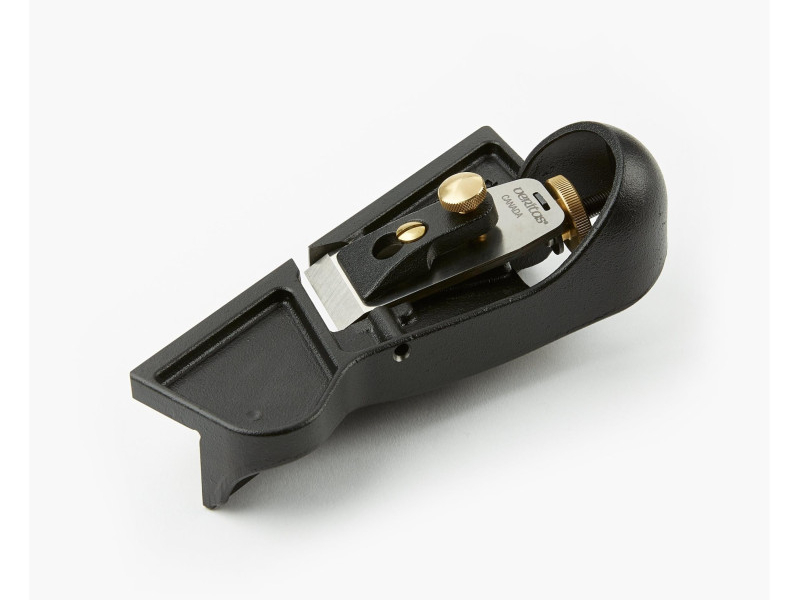


The Veritas side rabbet plane is used for cleaning up or trimming the sidewalls of rabbets, dadoes or grooves to give a perfect fit with the mating part, for those times when a joint does not fit the first time.
The Veritas side rabbet plane is used for cleaning up or trimming the sidewalls of rabbets, dadoes or grooves to give a perfect fit with the mating part, for those times when a joint does not fit the first time.
It has a practical dual-blade configuration and a pivoting handle that permits right- or left-hand use to suit the grain direction. The thin sole works like a skate, allowing use in slots as narrow as 3/16" and to a depth of 1/2". The toe is removable for stopped dadoes and has a trapped fixing screw to prevent loss. The depth stop helps orient and stabilize the plane, and is height adjustable and reversible without removing it from the body.
Sculpted to fit the hand comfortably, the handle has a spring-loaded pivot for sure positioning, so it will not move accidentally in use. The accurately machined 4-1/2" ductile cast iron body and the two O1 tool steel blades (Rc58-60) are lapped. Optional PM-V11 blades are available. A wave washer keeps the blades steady during set-up. Weighs 1 lb. Made in Canada. Patented.

Specific References
Yes, much of what you do with a router can be done with hand planes, quietly and without dust:
Router plane – flat bottoms in recesses, housings and inlays
Plough plane – grooves along the grain
Shoulder plane and rebate plane – rebates and tenons
Hand tools come in fewer sizes than router bits, so you have to adapt the dimensions to the blades available. In return you get full control and can work anywhere.
Which plane to start with depends on what you will do, but for most people a smoothing plane (No. 4) or a jack plane (No. 5) is a good first choice. The smoothing plane gives smooth surfaces, and the jack plane is a versatile plane for both rough work and truing edges.
Low-angle jack planes such as the Lie-Nielsen No. 62 and the Veritas low-angle jack are also popular all-round planes. A block plane is a good addition for end grain and chamfers. The guide explains how the hand plane is built and which types exist.
A shoulder plane and a rebate plane both have a blade that reaches the edges, but they are used for different tasks. The shoulder plane is narrow and precise and is used to trim tenon shoulders and adjust joints, often on end grain. The rebate plane often has a fence and depth stop and is used to cut rebates along an edge.
The guide explains when to choose which.
Planes of cast iron and steel rust easily, especially in unheated workshops and from moisture on your hands. Wipe the plane after use and protect bare surfaces with a thin layer of wax or oil that will not mark the wood.
Store your planes dry, ideally in a plane sock or box. If rust has already formed, the guide shows how to clean and protect them.
Most products are restocked on an ongoing basis, but delivery times from the manufacturer vary. When an item is out of stock, the button Notify me when available appears on the product page.
Click the button and enter your email address, and we will email you as soon as the item is back in stock. If you are logged in, your email address is registered automatically. If you want to know when the next delivery is expected, you are welcome to contact us.
How often items are restocked depends on the supplier. We receive deliveries from Veritas about once a month, Lie-Nielsen ships in batches and we order from Incra about once a year. You can also add the item to a wishlist in your account, where you can see whether it is in stock.
The Veritas side rabbet plane is used for cleaning up or trimming the sidewalls of rabbets, dadoes or grooves to give a perfect fit with the mating part, for those times when a joint does not fit the first time.