- -5%
- Pack
- Out-of-Stock


Instead of kr4,401.25
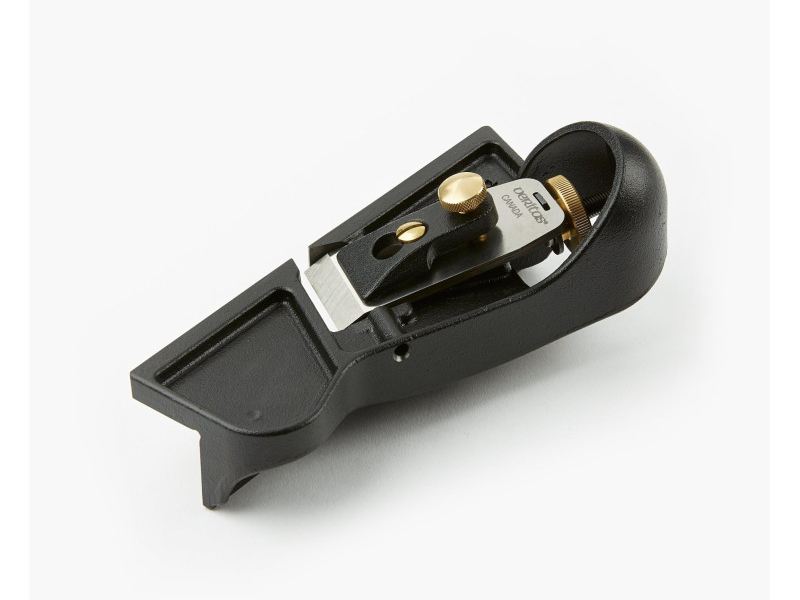
Veritas bevel-up jack rabbet plane with a PM-V11 blade. It takes large-scale rabbeting in stride.
Veritas bevel-up jack rabbet plane with a PM-V11 blade. It takes large-scale rabbeting in stride. Weighing 6 lb, with a full-width mouth and a 15 1/8" body similar to a jack plane, it is suitable for very large rabbets and fielded or bevelled panels, anywhere you need a long, wide cut that would take major effort with a smaller rabbet or shoulder plane. The long sole and substantial mass ensure accuracy; it will not follow the bumps and valleys a shorter plane would, and the 4 3/4" toe registers solidly on the work.
Set flush to both sides of the 2 1/4" body, the 3/16" thick bevel-up blade makes clean, accurate right- or left-hand corner cuts. The 15° bed and 25° bevel give an effective cutting angle of 40°. Scoring spurs on either side scribe the cut ahead of the blade, minimising tear-out across the grain. Adjustable for depth and projection, they can be recessed for working with the grain or so the outside spur cannot accidentally score the work.
Mounted on two steel fence rods with brass collet screws, the 7 3/8" removable fence can be set up to 5 1/4" from the shoulder and is through-drilled for a wooden extension. The rear tote tilts and locks to either side for knuckle clearance.
The stress-relieved ductile cast-iron body is accurately machined, with a sole flat and square to the sides. The adjustable mouth closes to a narrow slit for fine shavings or opens for heavier cuts. A Norris-style mechanism combines feed and lateral adjustment, and set screws on either side keep the blade from shifting while allowing full lateral adjustment. Supplied with a lapped PM-V11 blade. Patented.

Specific References
Veritas bevel-up planes hold the blade bevel up in a 12° bed. The cutting angle is therefore the bed angle plus the blade's bevel angle:
A 25° blade gives a 37° cutting angle – good for end grain and easy wood
A 38° blade gives a 50° cutting angle (York pitch) – a good start for difficult grain
A 50° blade gives a 62° cutting angle – for the most difficult wood
You change the cutting angle by swapping blades, or by honing a higher micro-bevel on the blade you have.
Which blade fits depends on the width of the plane. The blades come in A2, O1 and PM-V11 and with a 25°, 38° or 50° bevel:
1-5/8" – the Low-Angle Block Plane
1-3/4" – the Small Bevel-Up Smoother
2" – the Low-Angle Smooth Plane
2-1/4" – the Low-Angle Jack Plane, the 164 smoother and the Bevel-Up Jointer
Toothed A2 blades are also available for several of the planes, for difficult grain and for keying surfaces before veneering.
Veritas planes come with three types of steel. All give sharp edges, but they differ in how long the edge lasts and how easy the steel is to sharpen:
O1 – carbon steel that gets very sharp and is the easiest to hone
A2 – tool steel that holds an edge longer but takes a little longer to sharpen
PM-V11 – Veritas powder-metallurgy steel that holds an edge long and is still easy to sharpen
PM-V11 is the premium choice. O1 suits you if you sharpen often and want the keenest edge.
Most Veritas planes are supplied with a lapped blade, and the product name states which steel is included, for example A2, O1 or PM-V11.
Some versions are sold without a blade or as the body only, so you can choose the steel and bevel angle yourself. The name then says "without blade" or "body only". You will find matching blades among the Veritas replacement blades.
Which plane to start with depends on what you will do, but for most people a smoothing plane (No. 4) or a jack plane (No. 5) is a good first choice. The smoothing plane gives smooth surfaces, and the jack plane is a versatile plane for both rough work and truing edges.
Low-angle jack planes such as the Lie-Nielsen No. 62 and the Veritas low-angle jack are also popular all-round planes. A block plane is a good addition for end grain and chamfers. The guide explains how the hand plane is built and which types exist.
A shoulder plane and a rebate plane both have a blade that reaches the edges, but they are used for different tasks. The shoulder plane is narrow and precise and is used to trim tenon shoulders and adjust joints, often on end grain. The rebate plane often has a fence and depth stop and is used to cut rebates along an edge.
The guide explains when to choose which.
Planes of cast iron and steel rust easily, especially in unheated workshops and from moisture on your hands. Wipe the plane after use and protect bare surfaces with a thin layer of wax or oil that will not mark the wood.
Store your planes dry, ideally in a plane sock or box. If rust has already formed, the guide shows how to clean and protect them.
Most products are restocked on an ongoing basis, but delivery times from the manufacturer vary. When an item is out of stock, the button Notify me when available appears on the product page.
Click the button and enter your email address, and we will email you as soon as the item is back in stock. If you are logged in, your email address is registered automatically. If you want to know when the next delivery is expected, you are welcome to contact us.
How often items are restocked depends on the supplier. We receive deliveries from Veritas about once a month, Lie-Nielsen ships in batches and we order from Incra about once a year. You can also add the item to a wishlist in your account, where you can see whether it is in stock.
You might also like
Veritas bevel-up jack rabbet plane with a PM-V11 blade. It takes large-scale rabbeting in stride.