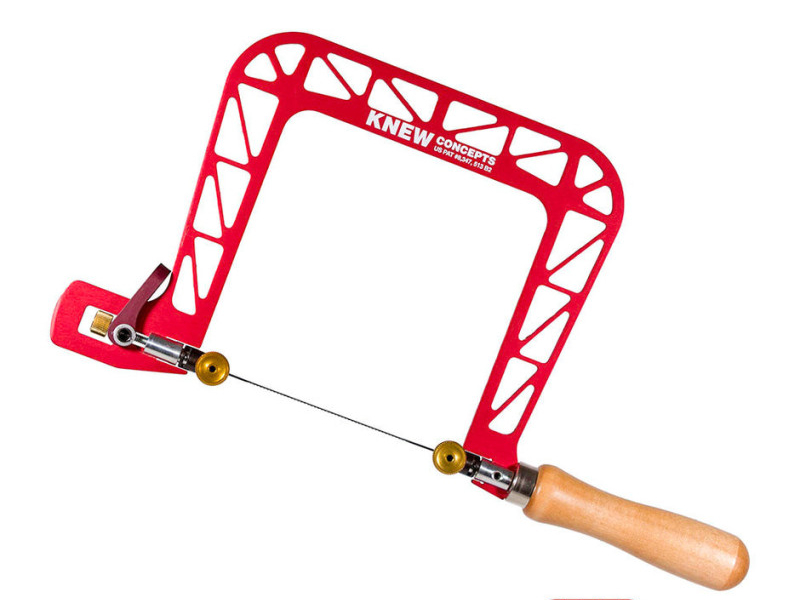


Knew Concepts Mk.V fret saw, 5" depth, with lever tension. The blade clamps have witness holes, so you can see the back of the blade to make sure you've really grabbed it.
Knew Concepts Mk.V fret saw, 5" depth, with lever tension.
The blade clamps have witness holes, so you can see the back of the blade to make sure you've really grabbed it. The extra length in the clamps gives them more to hold on to for improved grip, and the witness hole lets sawdust drop out of the bottom of the clamps to keep them grabbing solidly. The frame has the same triangulated truss design that makes the Mk.IV saws so much stronger, a major improvement over the older Mk.III design.
The lever version was designed for rapid, repetitive blade changes (when piercing, for example). The tension does not change when re-setting the blade: simply flip the lever forward to release tension, re-position and clamp the blade, and flip the lever to the rear, and you are sawing.
Saw type: Fret saw
All Knew Concepts fret saws have a strong, light aluminium frame that keeps the blade under high tension. The models differ like this:
Mk.III – the lightest model, with screw or lever tension
Mk.IV – a triangulated truss frame that tensions the blade to 23–27 kg, much stronger and with less vibration. Red powder coat.
Mk.V – the same strong frame as the Mk.IV, with longer blade clamps that have sight holes so you can see the blade is held
Titanium – a welded titanium frame, the strongest and stiffest
For the Mk.III, Mk.IV and titanium saws there is a foam handle grip that makes the handle thicker and easier on the hands.
The throat depth is the distance between the blade and the back of the frame, and decides how far in from the edge of the work you can cut:
3" (76 mm) – stiffest and lightest, best for small and fine work such as jewellery and marquetry
5" (127 mm) – the most versatile choice for most work
8" (203 mm) – reaches furthest into larger panels, but the frame is longer and slightly less stiff
If you are unsure, 5" is a good first choice. If you already have a saw, a 3" can be a good complement for detail work.
It comes down to how often you change or release the blade:
Lever / cam lever tension – flip the lever forward to release the tension, move the blade and flip it back. The tension is the same every time. Best when you cut many inside holes and often re-thread the blade.
Screw tension – the tension is set with a screw. Simpler and less expensive, and works well if you rarely change blades.
Swivelling blade clamps let you turn the blade a full turn with click stops every 45°, so you can make long cuts where the frame would otherwise hit the work.
Knew Concepts fret saws use standard plain-end blades, not pinned blades. All our wood and multi-purpose scroll saw and fret saw blades with plain ends fit, including in the deep 8" saws.
Each blade type comes in several numbers. Low numbers are thin with fine teeth for thin stock and tight curves, and high numbers cut faster in thick wood. Thanks to the high blade tension, the saws also handle the finest blades. A Skip No. 7 blade comes with the saw, and the blade length is 130 mm (5").
For silver and other metals you need metal-cutting blades. We cannot say exactly which size suits metal best, so it is a good idea to get a few different sizes. Low numbers are thin blades and high numbers are thick.
For wood, all fret saw blades work and it is mostly a matter of personal preference. Options include Skip (the blade fitted to the saw from the start), Double Skip (every other tooth missing) and Skip Reverse (teeth facing each other). Blades we often suggest include:
Skip size 4 and Skip size 6
Skip Reverse size 5R
Double Skip Reverse size 7R
MGT (Modified Geometry) 5SPR
For a Knew Concepts fret saw, choose blades that are 130 mm (5") long and pinless.
Which handsaw to choose depends on the tooth pattern and the number of teeth per inch (tpi). Rip teeth cut along the grain and crosscut teeth across it. Few teeth give fast but rough cuts, and many teeth give slower, cleaner cuts.
Backsaws such as tenon saws and dovetail saws are used for precise joinery. The guide covers tooth patterns, sharpening and choosing a saw.
You might also like
Knew Concepts Mk.V fret saw, 5" depth, with lever tension. The blade clamps have witness holes, so you can see the back of the blade to make sure you've really grabbed it.