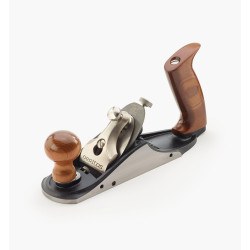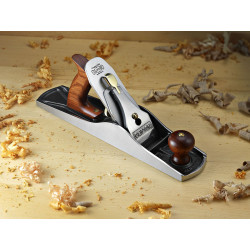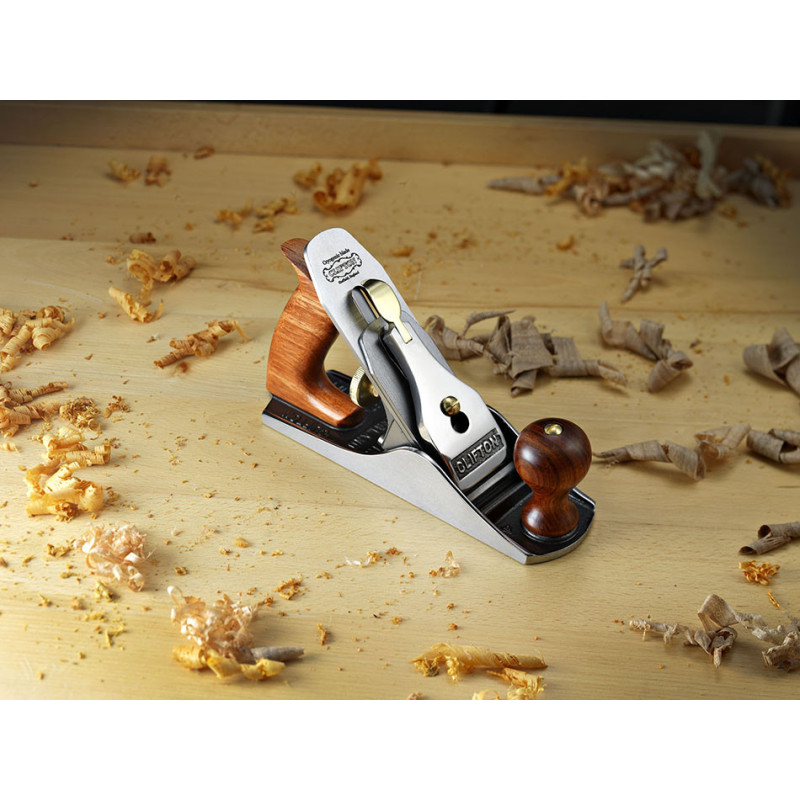

Clifton bench planes are accurate, smoothly functioning tools for the cabinet maker and discerning woodworker, whether amateur or professional.
Clifton bench planes are accurate, smoothly functioning tools for the cabinet maker and discerning woodworker, whether amateur or professional. The planes are ready to use straight from the box and do not need hours of flattening and fettling, though many woodworkers will prefer to hone the cutting iron themselves.
Materials:
Body and frog: accurately machined grey cast iron; sides and sole fully ground
Knob and handle: bubinga hardwood, carefully shaped, sanded and sealed
Cutting iron: hand forged high carbon steel, hardened and tempered to 60–62 Rockwell C, then precision ground; 0.120" (3 mm) thick
Cap iron: 2-piece, designed for rigid clamping
Frog locating pins and screws: ground and polished stainless steel
Lever cap: polished grey iron casting
Screws and adjusting wheel: polished brass
Y lever: solid one-piece casting
Adjusting lever and some other components: polished stainless steel
The frog and frog seating in the body are of the Bedrock design, first seen on early Stanley planes. This means the seating pad in the body is full face, fully machined to mate with an equivalent full face, fully machined underside of the frog. This ensures absolute stability of the frog, providing a firm and solid surface for the cutting iron, which again rests on a fully machined upper side of the frog. When allied to the extra thick Clifton cutting iron and cap iron, this design probably has the most rigid and effective clamping mechanism of any bench plane. The accuracy of this mechanism allows the cutting iron to be advanced to give a virtually "zero" mouth opening, allowing the finest shavings to be taken even in the most difficult timbers.
The Bedrock design uniquely allows the mouth width to be adjusted without dismantling the frog and iron assembly. To adjust the mouth width, move the frog backwards or forwards as required: loosen the outside two of the three screws located at the back of the frog seating pad (underneath the adjusting wheel), then turn the central screw clockwise to close the mouth and anti-clockwise to open it.
The sole is ground flat to within the British Standard for bench planes of 0.075 mm (0.003") and is individually checked before it leaves the factory. Castings can "move" with changes of temperature over the years, but Clifton minimises this by careful design of the castings and lengthy heat treatment.
You might also like
Clifton bench planes are accurate, smoothly functioning tools for the cabinet maker and discerning woodworker, whether amateur or professional.