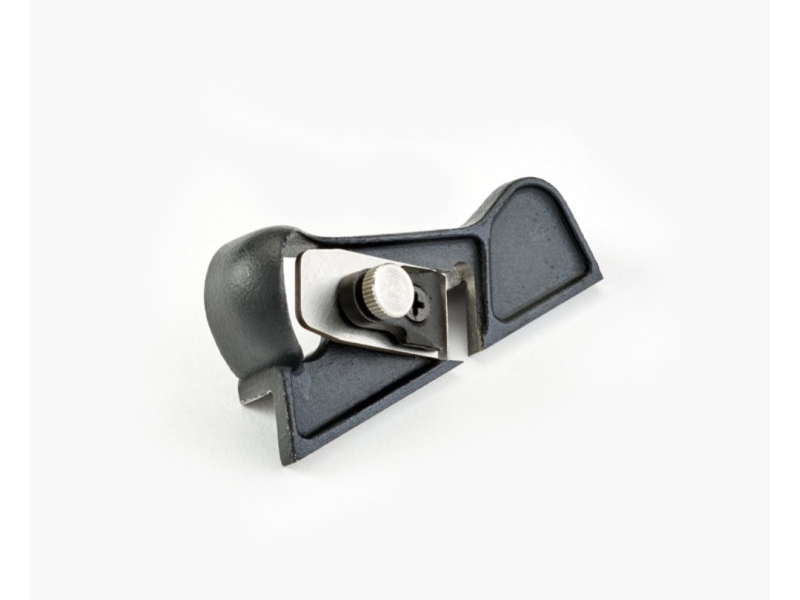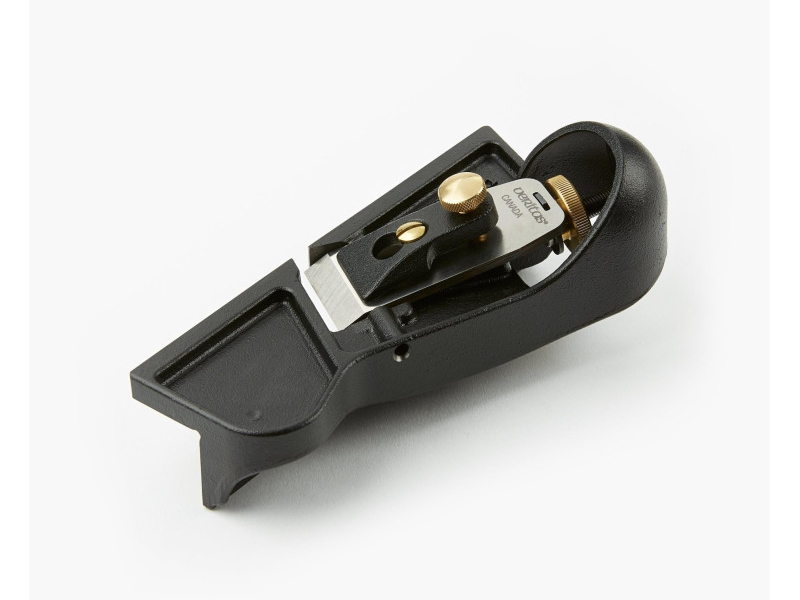


As with the other Veritas miniature planes, this tiny 3" wide router plane not only looks like its full-size counterpart, it works like it, too. Surprisingly comfortable to hold and maneuver, it is ideal for hardware installation and for fine inlay or intarsia work.
As with the other Veritas miniature planes, this tiny 3" wide router plane not only looks like its full-size counterpart, it works like it, too. Surprisingly comfortable to hold and maneuver, it is ideal for hardware installation and for fine inlay or intarsia work.
It comes with a 1/8" wide A2 tool-steel blade (hardened to Rc60-62) that can be positioned inboard for standard use or outboard for true bullnose work. The investment-cast stainless-steel body has been machined and the sole ground and lapped flat. The sole has also been designed to encircle the blade for maximum registration to a workpiece, and to bridge recesses for stability on narrow stock. The turned components are stainless steel, the locking collar is anodized aluminum, and the knobs are bubinga. A fine-screw feed mechanism sets blade depth; blades are secured with a knurled clamping knob. Weighs just 2 oz.
The A2 tool steel blade is best sharpened on a water stone. Hone the bevel and lap the bottom.
Supplied in an embossed, French-fitted presentation box, it is an outstanding gift for any woodworker. A corrosion-inhibiting paperboard chip is included in the case. It will provide continuous corrosion protection for up to two years.

Specific References
Yes, much of what you do with a router can be done with hand planes, quietly and without dust:
Router plane – flat bottoms in recesses, housings and inlays
Plough plane – grooves along the grain
Shoulder plane and rebate plane – rebates and tenons
Hand tools come in fewer sizes than router bits, so you have to adapt the dimensions to the blades available. In return you get full control and can work anywhere.
Yes. Veritas miniature tools always come with the blade fitted, and there is no other blade to choose. The product description tells you which steel the blade is made of.
On the full-size Veritas planes, such as the Veritas right-hand shooting plane, you choose the blade yourself, unless the product page says otherwise.
Which plane to start with depends on what you will do, but for most people a smoothing plane (No. 4) or a jack plane (No. 5) is a good first choice. The smoothing plane gives smooth surfaces, and the jack plane is a versatile plane for both rough work and truing edges.
Low-angle jack planes such as the Lie-Nielsen No. 62 and the Veritas low-angle jack are also popular all-round planes. A block plane is a good addition for end grain and chamfers. The guide explains how the hand plane is built and which types exist.
Planes of cast iron and steel rust easily, especially in unheated workshops and from moisture on your hands. Wipe the plane after use and protect bare surfaces with a thin layer of wax or oil that will not mark the wood.
Store your planes dry, ideally in a plane sock or box. If rust has already formed, the guide shows how to clean and protect them.
Most products are restocked on an ongoing basis, but delivery times from the manufacturer vary. When an item is out of stock, the button Notify me when available appears on the product page.
Click the button and enter your email address, and we will email you as soon as the item is back in stock. If you are logged in, your email address is registered automatically. If you want to know when the next delivery is expected, you are welcome to contact us.
How often items are restocked depends on the supplier. We receive deliveries from Veritas about once a month, Lie-Nielsen ships in batches and we order from Incra about once a year. You can also add the item to a wishlist in your account, where you can see whether it is in stock.
As with the other Veritas miniature planes, this tiny 3" wide router plane not only looks like its full-size counterpart, it works like it, too. Surprisingly comfortable to hold and maneuver, it is ideal for hardware installation and for fine inlay or intarsia work.