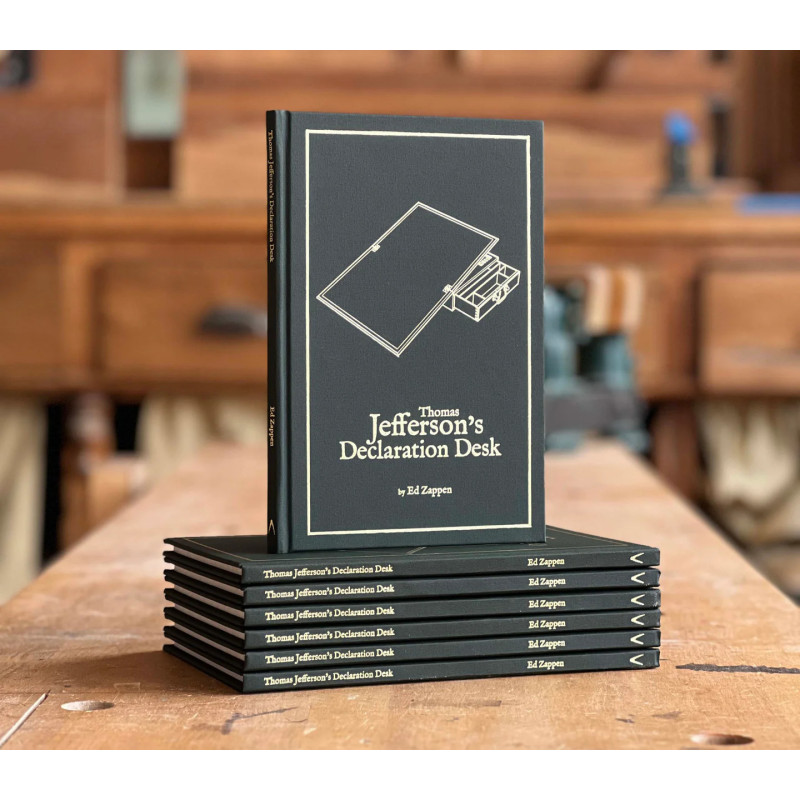

Thomas Jefferson's Declaration Desk by Ed Zappen, Lost Art Press. Known as the Declaration Desk, Thomas Jefferson's writing box is small and portable, with an adjustable sloped writing surface and a compartmented drawer for correspondence, writing materials and supplies.
Thomas Jefferson's Declaration Desk by Ed Zappen, Lost Art Press. Known as the Declaration Desk, Thomas Jefferson's writing box is small and portable, with an adjustable sloped writing surface and a compartmented drawer for correspondence, writing materials and supplies. It was on this desk that Jefferson wrote the Declaration of Independence in 1776.
Ed Zappen studied the desk and its history for more than 15 years and had access to the original, now in the Smithsonian, to record measurements and details. He tells the story of this artefact, summarises the events and people behind the American Revolution and gives a bibliography for further study. The book also provides construction drawings, details, techniques and plenty of colour photos to guide you in building a faithful replica.
The original was made by Philadelphia cabinetmaker Benjamin Randolph (1721-1791). It is a typical 18th-century desk, with a baize-covered bi-fold writing surface adjusted by a hinged support resting in stops on the box. The delicate drawer has tiny half-blind dovetails at the front and a thin satinwood inlay mirrored on the back of the mitred box. The drawer is divided into two inkwell compartments with a longer cubby for quills between, and room for paper behind.
The 80-page full-colour book is 9.5" × 6", sewn and hardbound in cotton cloth with foil stamping. Edward Zappen (1942-2025) was a Wisconsin circuit court judge, a retired Air Force Lt. Colonel, a lifelong woodworker and a Jefferson aficionado. He donated seven replicas of the desk to institutions including the Smithsonian, the American Philosophical Society and Monticello.
You might also like
Thomas Jefferson's Declaration Desk by Ed Zappen, Lost Art Press. Known as the Declaration Desk, Thomas Jefferson's writing box is small and portable, with an adjustable sloped writing surface and a compartmented drawer for correspondence, writing materials and supplies.