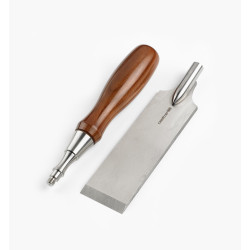
Veritas Flushing Chisel
Antique Flushing Chisels
Historically, this type of chisel is associated with the pattern maker’s trade.
Modern technology eliminated the handwork involved with making a mold pattern; as such, chisels made in this form are now seldom found.
The longer paring chisel supplants a normal cutting tool and allows for close, fine removal of excess material when refining a workpiece that may already be assembled. The longer blade provides a firm reference point when cutting to a flat surface.
Bent or “cranked-neck” versions were especially prized, as the clearance helped one retain control when cutting.
This later, American-made 1930s version had just one interchangeable handle used with a series of blades.
This two-piece construction provided greater control after heat treating and prior to finish grinding, controlling warping and giving a coplanar surface over the length of the blade. Edwin Walker first patented this type of chisel assembly in 1884 (#291,820) and refined it in 1886 (#357,429).